Mistral Large 4, explained: a trillion-parameter model, and specs Mistral's own pages can't agree on
Mistral AI launched Mistral Large 4 in public preview on 6 October 2026, internally nicknamed "Le Chonk" after a meme about a fictional oversized model that went viral months earlier. It's a genuinely large step up for Mistral, and also a launch where the company's own documentation, blog post and legal filings quote different parameter counts and context-window sizes for the same model. Here's what's actually confirmed, where the real ambiguity sits, and how it benchmarks against the frontier field independently.
Mistral Large 4 launched in public preview on 6 October 2026, a Mixture-of-Experts model with 52 billion active parameters, a figure Mistral's own blog and technical docs now agree on. The total parameter count is where Mistral's own materials still disagree: 1 trillion per the blog, 1.05 trillion per the technical docs, and a vaguer ">1 trillion" in its EU AI Act legal filing. VentureBeat's launch-day reporting separately cited 49 billion active parameters, a figure that doesn't appear anywhere in Mistral's own current materials.
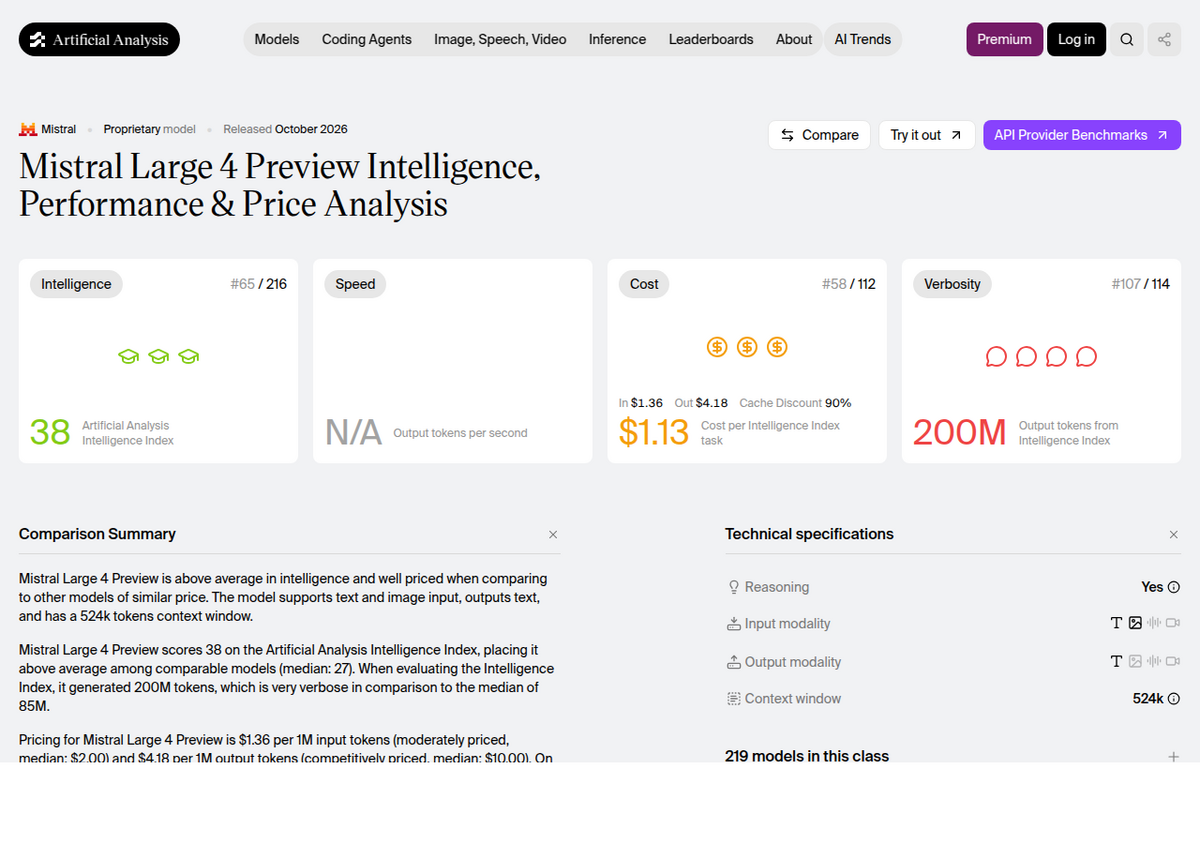
The context window has a similar gap. Mistral states 1 million tokens. Independent trackers Artificial Analysis and Vals.ai both measure closer to 512,000-524,000 tokens in practice, and even Artificial Analysis's own spec box and FAQ disagree with each other (524k vs 520k).
Independently, it scores respectably but not at the frontier. Artificial Analysis puts it at 38 on its Intelligence Index, rank 65 of 216 tracked models, above the category median but well behind Claude Opus 5.5 (58) and several Chinese open models.
It's API-only today, with no free tier. Open weights are promised "by end of October" per Mistral, with no confirmed date; a time-limited 50%-off launch discount brings pricing to $0.68/$2.09 per million input/output tokens through roughly 20 October.
What Mistral Large 4 actually is
Mistral Large 4 is a Mixture-of-Experts model Mistral describes as an "open-weight hybrid instruct-and-reasoning" system with multimodal input and text-only output: it accepts text and images (up to 8 per request, per Mistral's own EU AI Act compliance filing) but only ever writes text back, no image generation. It includes a separate 1.6-billion-parameter vision encoder for the image side, a detail confirmed in Mistral's technical documentation but absent from the company's own blog post and from most press coverage. The API exposes a reasoning_effort parameter, consistent with the "hybrid reasoning" framing: you can dial how much the model thinks before answering, trading latency for quality.
Mistral trained it on roughly 3,800 Nvidia Grace Blackwell GPUs (Mistral's own figure; press coverage rounds this to "about 4,000") over about two months, covering 160-plus languages including every official EU language. Mistral VP of Science Pierre Stock told TechCrunch the training run used "two to three times less" compute than unnamed Chinese competitors, an efficiency claim worth noting as company-sourced rather than independently verified. One detail worth taking seriously before judging the model too harshly on any single benchmark: Mistral's own blog states reinforcement-learning training was "still in flight" at launch, meaning the public-preview checkpoint is explicitly an unfinished model, not Mistral's final version.
The "Le Chonk" nickname has a specific, verifiable origin: in June 2026 a joke spread online about a fictional model called "Le Chaton Fat" with fabricated 30-trillion-parameter benchmarks. Mistral CEO Arthur Mensch played along on social media at the time, and when Mistral Large 4 actually shipped as a genuinely oversized model months later, the internal nickname stuck, with Mensch reportedly joking it's "actually le gros chaton." It's a small detail, but it's the kind of thing that tells you Mistral is aware of, and comfortable with, its own "big model" positioning this time around.
The total parameter count depends which Mistral page you read
Source                                Total params      Active params
---------------------------------------------------------------------------
Mistral's launch blog post             1 trillion         52 billion
docs.mistral.ai model page              1.05 trillion       52 billion
VentureBeat (launch-day reporting)      1 trillion          49 billion
EU AI Act technical documentation       ">1 trillion"       not disclosed
  (legal filing)

Mistral's blog and technical docs now agree on 52 billion active
parameters. The total count still varies across Mistral's own materials,
and VentureBeat's widely-repeated 49 billion figure doesn't appear in any
current Mistral-published page we could find.
That legal filing is worth a second look for a different reason. Mistral's EU AI Act technical documentation for downstream providers, the compliance disclosure required for operating in the EU, lists the model's maximum text input and output at a flat "250 tokens." That number is almost certainly a template field Mistral never filled in correctly rather than a real limit (every other source, including Mistral's own docs, states a context window in the hundreds of thousands to a million tokens), but it's a genuine, verifiable oddity in Mistral's own official paperwork: we rendered the filing directly rather than relying on an automated text extraction, and the figure is printed exactly that way. Don't cite 250 tokens as a real constraint; do treat it as a sign that Mistral's compliance documentation for this launch was rushed.
Context window: 1 million tokens claimed, around half that measured
Mistral's own documentation states a 1,000,000-token context window, the figure repeated in most launch coverage. Independent API trackers measure something smaller in practice: Vals.ai lists a 512,000-token context window with a 256,000-token maximum output, and Artificial Analysis's specifications box and its own FAQ page disagree with each other, 524,000 versus 520,000 tokens. None of these three independent numbers matches Mistral's 1M claim, and the two independent trackers don't even agree with each other precisely. If a workflow depends on genuinely using the full million-token window, test with your own long document before building around that number; the gap between claimed and measured capacity here is large enough to matter.
Pricing, and a discount that's already ticking down
Tier                      Input ($/M tokens)   Output ($/M tokens)
---------------------------------------------------------------------
List price                 1.36                  4.18
Launch discount (50% off,   0.68                  2.09
  ~2 weeks from 6 Oct)
Cached input, discounted    0.07                  n/a

Mistral's own changelog states the discount runs roughly two weeks from
launch, putting the likely end date around 20 October 2026. No exact end
date is published on the pricing page itself, so confirm the live price
on Mistral's own console before relying on it.
How it benchmarks, independently measured
Artificial Analysis, which runs every model through the same standardized Intelligence Index rather than taking a vendor's self-reported score, puts Mistral Large 4 at 38, ranked 65th of 216 models tracked, against a category median of roughly 26-27. That's a genuinely above-average result and a large jump from Mistral's own prior flagship (more on that below), but it's not a frontier result: Claude Opus 5.5 leads the chart at 58, Claude Sonnet 5.5 sits at 51.9, and several open-weight Chinese models, MiMo-V2.6-Pro (46), GLM-5.3 (45) and Qwen 3.8 Max (45.4), all score higher than Mistral Large 4 on the same index. Mistral's own framing, "the strongest model from outside the US and China," holds up against Western closed competitors like GPT-6 Luna (roughly 37-38), but not against those Chinese open models, which is a meaningfully narrower claim than the headline suggests. For scale, the same week's other major launch, the API-reachable tier of Meta's Muse Wonder, scores 52 on the same independent index, well ahead of Mistral Large 4.
Two independent numbers matter more than the headline score if you're deciding whether to actually use this model. First, hallucination rate: Artificial Analysis's AA-Omniscience measurement puts it at 41.9%, flagged by independent reviewer eesel.ai as the single biggest weak point in this launch, worth knowing before using it for anything where a wrong-but-confident answer is costly. Second, latency shape: once it starts streaming, output runs at a reasonable 116 tokens per second, but time-to-first-token on long prompts measured around 18.7 seconds, fast once it gets going, slow to start. That's a bad combination for a live chat interface and a fine one for a batch job that can tolerate a startup delay.
Vals.ai, a separate independent tracker with a different comparison set skewed toward stronger frontier models, scores it lower in relative terms: 48.05% on the Vals Index, rank 35 of 47. Its best relative showing is Harvey's Legal Agent Benchmark, a legal-document task where it ranks 9th of 79, a respectable placement even though the raw score (15.83%) looks unimpressive on its own, since legal-reasoning benchmarks of this type score low across the board. Its weakest showing is MysteryMechanism, where it finishes dead last, 27th of 27. On cybersecurity specifically, Mistral's own self-reported figures (82-93% on vulnerability reproduce-and-patch tasks) need a caveat that reviewers at apidog flagged directly: Claude Opus 5.5 and GPT-6 Astra score near zero on the same self-reported comparison not because they can't do the task, but because they refuse it on safety grounds. That's a methodology difference, not a pure capability gap, and Mistral's own materials don't make that distinction clear.
Mistral Large 4 vs. Mistral Large 3
                          Mistral Large 3        Mistral Large 4
------------------------------------------------------------------------
Total / active params      675B / 41B             ~1T-1.05T / 52B
Training hardware          3,000 Nvidia H200       3,800 Nvidia Blackwell
Released                    ~December 2025          6 October 2026
AA Intelligence Index       9                       38 (~4.2x higher)
Verbosity (output tokens     9.8M                    200M (~20x more
  to run full Index)                                  verbose)
Cost per Index task          $0.03                   $1.13 (~38x higher)

Intelligence Index, verbosity and cost figures are Artificial Analysis's
own independent measurements, not Mistral-reported.
The capability jump from Large 3 to Large 4 is real and substantial by Artificial Analysis's independent measure, roughly 4 times the Intelligence Index score. It comes with a steep cost: the model is about 20 times more verbose on the same evaluation, and the price to run a single Intelligence Index task rose from $0.03 to $1.13, roughly 38 times higher. If you're weighing whether to upgrade a workflow built on Large 3, budget for that cost increase explicitly rather than assuming a newer, smarter model is automatically cheaper to run per task.
Open weights: "end of October," but not confirmed
Mistral's own blog and changelog both describe open weights as coming "by the end of the month" or simply "coming soon," without a specific date. VentureBeat's reporting states a specific target of 27 October 2026, framed as the end of a roughly three-week testing period with developers, cybersecurity researchers and government authorities, but that date is VentureBeat's own inference from Mistral's "three-week" framing, not a date Mistral itself has published. TechCrunch's coverage is vaguer still, citing "just three weeks" after the 6 October launch. Treat late October as directionally right and 27 October specifically as unconfirmed. The license for the eventual open release also isn't finalized: VentureBeat reports Mistral expects to use a custom Mistral license rather than a standard one like Apache 2.0 or MIT, but that hasn't been published either, and today's access is governed only by Mistral's terms of service and self-deployment agreement.
How to access it today
Right now, the only confirmed way to use Mistral Large 4 is through Mistral's own API documentation or Mistral Studio console, under the model ID mistral-large-4 (listed on the docs page as mistral-large-4-0). TechCrunch specifically describes current access as limited to "a public guardrail endpoint," worth keeping in mind if you need unrestricted access for a sensitive workload. It's also already listed on third-party gateways including OpenRouter (as mistralai/mistral-large-4-0), Eden AI and LLMGateway. We could not confirm whether it's live yet inside Vibe, Mistral's own consumer chat app (renamed from Le Chat in May 2026, with accounts and subscriptions carrying over); Mistral's announcement links to Vibe without stating the model is available there, so verify directly on chat.mistral.ai before assuming you can try it there for free.
Should you use it
- EU-sovereign hosting or multilingual work across official EU languages: a reasonable fit, and one of Mistral's clearest differentiators against US and Chinese labs.
- Long legal or compliance documents: Harvey's Legal Agent Benchmark ranking (9th of 79, independently measured) suggests real strength here, though the raw score is modest in absolute terms.
- Live chat or latency-sensitive applications: a weaker fit given the roughly 18.7-second time-to-first-token on long prompts, even though output speed once started is fine.
- Anything where a confident wrong answer is costly: the independently measured 41.9% hallucination rate is the single most-cited weak point across reviewers; verify outputs rather than trusting them outright.
- Cutting-edge coding or latency-sensitive agentic work: a weaker fit. Its Artificial Analysis Intelligence Index (38) trails several Chinese open models (MiMo-V2.6-Pro at 46, GLM-5.3 at 45, Qwen 3.8 Max at 45.4) that are also open-weight, with that comparison likely to matter most to developers picking a coding model.
People also ask
Is Mistral Large 4 free?
No free tier exists. It's API-only, billed per token, with a time-limited 50%-off launch discount (roughly $0.68/$2.09 per million input/output tokens) that Mistral's own changelog says runs about two weeks from the 6 October 2026 launch.
Is Mistral Large 4 open source or open weight?
Not yet. Mistral describes it as intended to be open-weight and promises weights "by end of October" 2026, with VentureBeat reporting a specific but unconfirmed target of 27 October. The license hasn't been finalized; Mistral expects to use a custom license rather than a standard one like Apache 2.0.
How many parameters does Mistral Large 4 have?
52 billion active parameters, a figure Mistral's own blog and technical docs now agree on. The total parameter count still varies across Mistral's own materials: 1 trillion per the launch blog, 1.05 trillion per the technical docs. VentureBeat's launch-day reporting separately cited 49 billion active parameters, a figure not found in Mistral's own current pages.
What is Mistral Large 4's actual context window?
Mistral states 1 million tokens. Independent trackers measure less in practice: Vals.ai lists 512,000 tokens, and Artificial Analysis's own specification box and FAQ disagree with each other at 524,000 versus 520,000 tokens.
How does Mistral Large 4 compare to Mistral Large 3?
About 1.5 times the total parameters on newer Nvidia Blackwell hardware. Independently, Artificial Analysis measures roughly a 4x jump in Intelligence Index score (9 to 38), but with about 20 times higher output verbosity and per-task evaluation cost rising from $0.03 to $1.13, roughly 38 times higher.
Does Mistral Large 4 hallucinate a lot?
Artificial Analysis's AA-Omniscience measurement puts its hallucination rate at 41.9%, flagged by independent reviewer eesel.ai as the model's single biggest weak point. Verify factual outputs rather than trusting them outright, especially for unfamiliar or niche topics.
What is Mistral Large 4 best at?
Independently measured strengths include legal and long-document work (a respectable rank on Harvey's Legal Agent Benchmark) and cybersecurity vulnerability-reproduction tasks, though Mistral's self-reported cyber scores need the caveat that some rival models score near zero on the same test because they refuse the task on safety grounds, not because they can't do it.
Export your NotebookLM in one click
Free Chrome extension. PDF, Word and Markdown. Rendered on your machine — nothing uploaded.