Which Gemini model does NotebookLM actually use? The full version history, verified
Gemini Notebook, formerly NotebookLM, currently runs on Gemini 3.5 for Pro and Ultra subscribers, but Google has never put that model name in its own consumer-facing copy, and a surprising number of "how to use NotebookLM" pages still describe a model version that stopped being current over a year ago. Here's every documented upgrade with dates and sources, what's confirmed versus estimated, why three newer Gemini releases since August still haven't reached the product, and why there's no model picker to check it yourself.
As of August 2026, Gemini Notebook runs on Gemini 3.5 for Ultra and Pro subscribers on the web, part of an upgrade (alongside a secure cloud computer for code execution and 11 export formats) that started rolling out on 8 June 2026 and reached general Pro availability around early August. Google's own blog post announcing the rename to Gemini Notebook never actually names "Gemini 3.5" in its text; that specific model name comes from press coverage reading between the lines, not from Google's own copy.
Which exact model the free tier runs is not confirmed anywhere in Google's own documentation. The free tier was explicitly excluded from the June 2026 rollout, and no primary source states it has since been upgraded to match. Treat any claim that free-tier Gemini Notebook runs Gemini 3.5 as unverified.
There is no model picker. Gemini Notebook chooses the model automatically and has never shown an in-app indicator of which version is answering, before or after any of its upgrades.
Video Overviews use a different, separate model: Nano Banana Pro, not plain Nano Banana. Google's own 4 March 2026 announcement names "Cinematic Video Overviews" as a combination of Gemini 3 (as creative director), Nano Banana Pro (imagery), and Veo 3 (the final animated video), not whatever text model is currently answering your chat questions. Audio Overviews are a separate, older feature and aren't documented as running on any of these.
Three newer Gemini releases since August still haven't reached Gemini Notebook. Gemini 3.7 Flash, Gemini 3.8 Flash, and the restricted Gemini 4 Argon are all real, dated releases, but none is a Gemini Notebook upgrade; see the dedicated section below for why.

The full version history
Google has never published a single changelog page tracking NotebookLM/Gemini Notebook's underlying model version, so this history is reconstructed from Google's own announcement posts where they exist, and flagged as press-sourced or unconfirmed where a primary citation doesn't exist. If you've read a stale "NotebookLM runs on Gemini 1.5 Pro" claim somewhere, this table shows exactly how many upgrades have happened since that was last true.
Date              Model                          Confirmed by
--------------------------------------------------------------------------------------------
May 2023 launch   Gemini Pro / PaLM 2-era stack   General launch coverage; no single primary source
                                                    pins the exact split (launched as "Project Tailwind")
~2024             Gemini 1.5 Pro                  Press coverage; exact month unconfirmed
2024-early 2025   Gemini 2.0 Flash                Press coverage; exact date unconfirmed
May 2025          Gemini 2.5 Flash                Tied to the Android/iOS mobile app launch
October 2025      (context window expanded         Same 2.5 Flash model, larger context ceiling
                   toward Gemini's 1M-token cap)
19 Dec 2025       Gemini 3                        NotebookLM's own official X/Twitter post:
                                                    "officially built on Gemini 3!" (Pro vs Flash
                                                    variant not stated); see 9to5google's writeup
8 Jun 2026        Gemini 3.5 + "Antigravity"      Press coverage (ppc.land, 9to5google); Ultra +
                  agentic framework, cloud          enterprise users at launch, free tier
                  computer, 11 export formats       explicitly excluded
16 Jul 2026       (renamed to Gemini Notebook;     Google's official blog.google rename post, which
                   3.5 rollout continuing)           never names "Gemini 3.5" explicitly in its own text
~5 Aug 2026       Pro tier rollout completed        Press coverage only; not confirmed on a primary
                                                    Google page

Sources checked directly: blog.google's rename announcement, NotebookLM's own X
account, Google's Gemini Notebook support FAQ. Where a row says "press coverage,"
no equivalent primary-source Google page could be found stating that date.
Two of these dates are worth reading in the original coverage rather than taking on faith. 9to5Google's report on the Gemini 3 upgrade is the clearest secondary confirmation of the December 2025 switch, built directly on NotebookLM's own social post rather than a Google blog entry, since Google never published a dedicated announcement for that specific upgrade. The June 2026 jump to Gemini 3.5 is documented in more detail by ppc.land's writeup and 9to5Google's own coverage of the code-execution and 11-format upgrade, both of which specify the Ultra-and-enterprise-first rollout that Google's own rename post later referenced without repeating the model name.
Why Google doesn't name the model in its own copy
This isn't an oversight. Across Google's official Gemini Notebook rename post and its support FAQ pages, the consistent pattern is describing the product in terms of capability and subscription tier, not model version number. That's a deliberate framing choice consumer-product teams commonly make so that a future silent model swap doesn't require rewriting user-facing documentation, but it does mean that every specific model name in circulation, Gemini 3, Gemini 3.5, comes from press coverage and NotebookLM's own social posts rather than from an evergreen Google page you can check today and trust to stay current. A 15 September 2026 Google blog post announcing new Gemini Notebook study tools, real-time voice, a mobile lecture recorder, interactive learning overviews, continues the same pattern: real features, real dates, no model name anywhere in the post.

Does the model differ by tier or feature?
By subscription tier: the clearest documented split is that the June 2026 Gemini 3.5 upgrade launched for Ultra subscribers and enterprise users first, reached general Pro availability by early August 2026 per press coverage, and explicitly excluded the free tier at launch. No source confirms whether the free tier has since been brought up to the same model; until Google states that directly, the honest answer is unconfirmed, not "probably yes."
By feature within the product: no source we could find documents a distinct chat model for Deep Research specifically versus ordinary chat inside Gemini Notebook. The one confirmed exception is Video Overviews, whose visual styles and animated illustrations come from Nano Banana, Google's dedicated image-generation model, rather than whatever text model is currently answering chat questions. That's worth knowing if a chat-model upgrade doesn't seem to change how Video Overviews look: it's a genuinely different model doing that specific job. Audio Overviews are an older, separate feature, and no source documents them running on Nano Banana specifically; treat any claim connecting the two as unconfirmed.
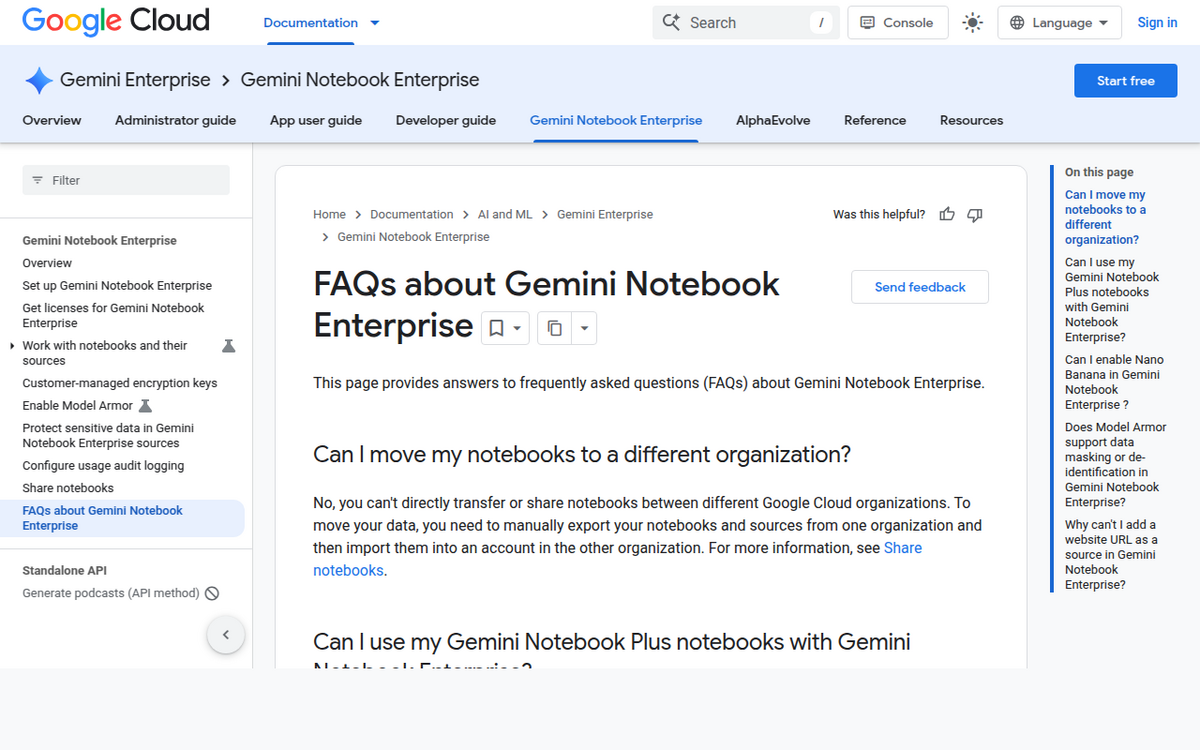
By deployment (Enterprise vs. consumer): Gemini Notebook Enterprise's documented differences are governance controls, VPC Service Controls, customer-managed encryption keys, and a no-training guarantee on your data, not a different underlying model. Google Cloud's own Enterprise FAQ, last updated 7 October 2026, directly confirms Nano Banana Pro video generation still isn't supported in Gemini Notebook Enterprise at all, consumer and enterprise aren't just running different models, they don't have the same feature set to begin with. If you're choosing Enterprise specifically hoping for a more capable model or the video feature, that's not what the tier is selling; our Gemini Notebook Enterprise guide covers what actually changes.
No model picker, and no in-app indicator
No model picker has ever shipped to users, and press coverage of past upgrades has specifically noted the absence of any in-app signal that a new model is now live. After the December 2025 Gemini 3 upgrade, 9to5Google reported there was no in-app indicator that a new model was in use at all; users found out from NotebookLM's own social post, not from anything inside the product. The June 2026 upgrade didn't change that pattern, and no Gemini Notebook picker has shipped since. Two different reports get conflated in some coverage, worth separating clearly: a Gemini-Notebook-specific Fast/Thinking selector was reported as "set to receive" by testingcatalog.com in December 2025, tied to the Gemini 3 rollout, and never shipped. A different, unrelated Fast/Thinking/Pro picker did ship, but in the separate Gemini app, not Gemini Notebook, reported by 9to5Google on 17 December 2025, two days before NotebookLM's own Gemini 3 announcement. If you've seen a screenshot of a Gemini model picker, it's almost certainly that Gemini app feature, not Gemini Notebook, which remains fully automatic today. If you want to know what model you're currently talking to, checking recent press coverage and this page is currently more reliable than checking inside the product itself.
What Google has published about capability, if not model name
Alongside the June 2026 upgrade, Google published self-reported benchmark figures: a 65% average win rate versus the prior chat system in internal evaluations, 78.2% on web-research-style tasks, and 69.9% on document-analysis tasks. These are Google's own numbers, not independently reproduced by a third party, so treat them the way you'd treat any vendor's self-reported benchmark: a directional claim of real improvement, not a settled, externally-verified score. No source states a context-window figure specific to Gemini Notebook's chat feature that differs from Gemini's general context-window ceiling; the context-window figures you'll see quoted for the product describe the overall model capability, not a NotebookLM-specific limit layered on top.
Model transparency: how Gemini Notebook compares to ChatGPT and Claude
This invisible-model approach is specifically a Gemini Notebook trait, not an industry norm. ChatGPT shows a model picker directly in its interface, so a user can see and choose whether they're on GPT-5.4, GPT-5.4 mini, or another available option before sending a message. Claude's interface likewise names its active model (Sonnet 5 on free and Pro, Opus 5 or Fable/Mythos 5 on higher tiers) in the model selector, and Anthropic's own release notes track version changes explicitly enough that our Claude free-tier guide can state the exact default-model switch date. Gemini Notebook is the outlier among the three in offering neither a picker nor a visible label, which is consistent with its broader design philosophy of hiding infrastructure details behind capability descriptions, but it does mean a user who cares about exactly which model is answering has to rely on outside reporting like this page rather than anything the product itself surfaces.
What about Gemini 3.7 Flash, 3.8 Flash, and Gemini 4 Argon?
Three more Gemini-family models have shipped since the June 2026 Gemini 3.5 upgrade, and none of them changed what Gemini Notebook runs. Gemini 3.7 Flash, released 13 August 2026, is a coding-and-agents-focused model distributed through the Gemini API, Vertex AI, AI Studio, and developer tools like GitHub Copilot; Google's own model card never mentions Gemini Notebook. Gemini 3.8 Flash, released 2 September 2026 via Google's own blog, follows the identical pattern: an API/developer release, not a consumer product upgrade. Gemini 4 Argon, announced 30 September 2026, is the most clearly ruled out of the three: Google restricts it entirely to the Fairwind Program, a vetted cybersecurity-defender partner track requiring background checks and phishing-resistant multi-factor authentication, with no public release date and no redistribution allowed. None of these three is a Gemini Notebook upgrade path, and as of this writing Gemini Notebook's documented chat model is still Gemini 3.5 from June 2026, not any of the three newer releases.
Where competing coverage gets this wrong
The most common error, still visible on generic "how to use NotebookLM" tutorial pages and library research guides, is stating flatly that NotebookLM "runs on Gemini 1.5 Pro," a fact that was accurate roughly two model generations ago and has been superseded at least three times since (2.0 Flash, 2.5 Flash, Gemini 3, then Gemini 3.5). Even reference pages that get the recent history mostly right, including Wikipedia's own Gemini Notebook article, tend to skip the intermediate 1.5 Pro, 2.0 Flash, and 2.5 Flash steps entirely and jump straight from launch to Gemini 3, which flattens a version history that actually had several distinct upgrades in between.
People also ask
Does NotebookLM use Gemini Pro or Gemini Flash?
Historically, Flash-tier variants (2.0 Flash, then 2.5 Flash). Since the December 2025 upgrade to Gemini 3 and the June 2026 upgrade to Gemini 3.5, Google has not specified a Pro-vs-Flash variant for either release in its own communications.
Can I choose which Gemini model NotebookLM uses?
No. Model selection is fully automatic, and Gemini Notebook has never shown an in-app indicator confirming which model version is currently answering, even immediately after a documented upgrade.
Does the free version of Gemini Notebook use the same model as Pro?
Unconfirmed. The free tier was explicitly excluded from the June 2026 Gemini 3.5 rollout at launch, and no primary source has since stated that it was brought up to match. Don't assume parity until Google confirms it directly.
Is NotebookLM Enterprise powered by a more advanced model?
No evidence supports that. Documented differences for Enterprise are governance features (VPC Service Controls, customer-managed encryption keys, a no-training guarantee), not a different underlying model.
What model generates NotebookLM's Video Overviews?
The visual styles and animated illustrations in Video Overviews come from "Nano Banana," Google's dedicated image-generation model, a separate model from whatever text model is currently answering chat questions. Audio Overviews are a separate, older feature; no source documents them running on Nano Banana, so don't assume the two share a model.
How can I tell when Gemini Notebook has switched to a new model?
You currently can't tell from inside the product itself. Every past upgrade has been confirmed through NotebookLM's own social posts or press coverage rather than an in-app notification, so watching official announcements and independent reporting is the only reliable way to know a switch happened.
Is Gemini Study Notebooks the same as Gemini Notebook?
No, they're two different Google products that happen to share a name. Study Notebooks is a feature inside the Gemini app, launched 25 June 2026, that generates personalized lessons, quizzes, and progress dashboards. Gemini Notebook (formerly NotebookLM) is the standalone source-grounded research tool this article covers. Our Gemini Study Notebooks guide covers the distinction in full.
Did Gemini 3.7 Flash, 3.8 Flash, or Gemini 4 Argon upgrade Gemini Notebook's model?
No. All three are separate releases on separate tracks: 3.7 Flash and 3.8 Flash are developer/API models with no documented connection to Gemini Notebook, and Gemini 4 Argon is restricted entirely to Google's vetted Fairwind cybersecurity-partner program with no public release date. Gemini Notebook's documented chat model remains Gemini 3.5 from the June 2026 upgrade.
Esporta il tuo NotebookLM in un clic
Estensione gratuita per Chrome. PDF, Word e Markdown. Elaborata sul tuo dispositivo — niente viene caricato.