NotebookLM Plus vs Pro: what's the difference, now that the daily limits are gone?
One sentence: Plus and Pro are two separate paid tiers bundled with different Google AI subscriptions, Plus at $4.99 a month and Pro at $19.99, with Pro giving roughly double Plus's usage budget. What changed since this guide first ran in July: Google quietly replaced every fixed daily limit (chats per day, Audio Overviews per day) with a single compute budget, and split the Ultra tier in two.
NotebookLM was renamed Gemini Notebook in July 2026. This guide covers the same product under its new name: everything below still applies whether you know it as NotebookLM or Gemini Notebook.
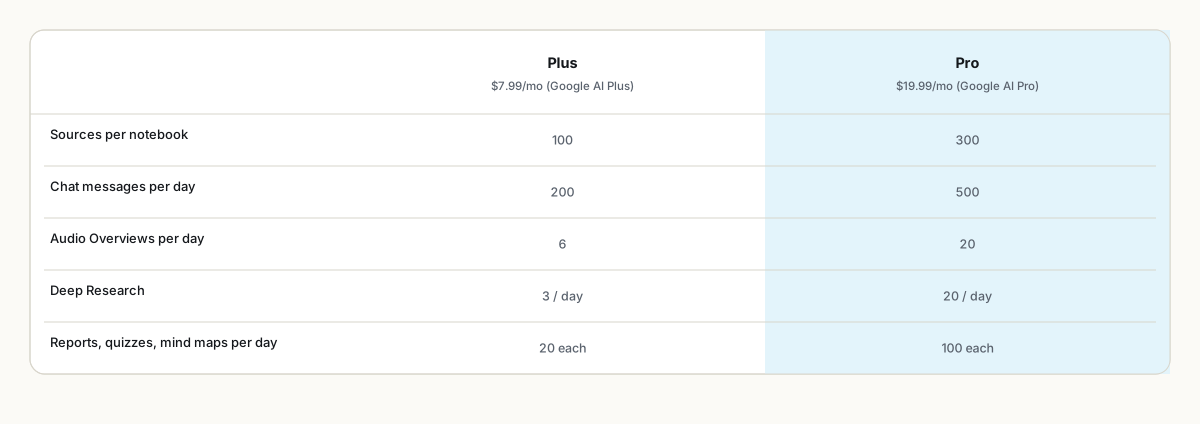
NotebookLM Plus comes bundled with Google AI Plus ($4.99/month): 100 sources per notebook, 200 notebooks, and 2x the standard usage budget. NotebookLM Pro comes with Google AI Pro ($19.99/month): 300 sources, 500 notebooks, and 4x the standard budget. Both sit above the free tier; neither is the free plan.
The daily limits you may remember (200 chats/day, 6 Audio Overviews/day on Plus) no longer exist. Since 2 September 2026, Gemini Notebook replaced every fixed per-feature cap with a single compute budget that recharges every 5 hours, the same system the Gemini app uses. Plenty of pricing pages online still show the old fixed numbers as current; they're describing a system Google retired over a month ago.
The naming is genuinely confusing
"Plus" sounds like it should be the cheaper add-on and "Pro" the premium tier, and that intuition is correct here, but the two names are easy to mix up with the free plan too. To be explicit: the free plan is free. Plus and Pro are both paid, and Pro costs more than Plus for a genuinely larger usage budget. Neither name refers to a specific Gemini Notebook-only purchase; both are inherited from the Google AI subscription (Google AI Plus, Google AI Pro) they come bundled with.
What changed on 2 September 2026
For most of 2026, Gemini Notebook rationed usage the way this guide originally described it: a fixed number of chat messages per day, a fixed number of Audio Overviews per day, separate daily caps for Deep Research, reports, flashcards, quizzes, and mind maps. Google announced the change on 28 August 2026 and began rolling it out to consumer accounts on web and mobile on 2 September 2026: a single compute-based usage budget that recharges every 5 hours, with a weekly ceiling layered on top, replacing the daily caps entirely. Available usage now depends on how much compute a task actually requires, prompt complexity, which model and feature you're using, chat length, and how many sources are attached to the notebook, rather than a flat per-feature count. The same update added the option to defer resource-intensive outputs like Video Overviews and Slide Decks for later generation instead of running them immediately.
The multiplier is what actually separates the tiers now: Free gets the standard budget, Plus gets 2x the standard budget, Pro gets 4x, and Ultra gets either 5x or 20x Pro's budget depending on which Ultra SKU you're on (more on that split below). Google hasn't published what the standard budget translates to in, say, chat messages or Audio Overviews, which makes the old fixed numbers impossible to directly replace with new ones; the honest comparison is the multiplier itself. Several third-party pricing roundups still publish the pre-September fixed numbers ("Pro: 500 chats/day") as if they're current. They aren't, and there's no current equivalent to check them against.
What that looks like in practice: a short chat question against a 10-source notebook draws very little from the budget, while a 20-minute Audio Overview generated from a 200-source notebook, or a Deep Research run that crawls dozens of external pages, draws much more, because both chat length and source count factor into the compute cost. Two Plus subscribers doing the same number of "things" per day can burn through the 5-hour window at very different rates depending on notebook size and feature mix, which is exactly why Google moved away from a flat per-feature count in the first place: a fixed "200 chats/day" never reflected that a one-line question and a Deep Research query cost wildly different amounts of underlying compute.
Source and notebook caps, side by side
Unlike the usage budget, source and notebook limits are still published as fixed numbers and haven't changed in this update:
- Free: 50 sources per notebook, 100 notebooks.
- Plus: 100 sources per notebook, 200 notebooks.
- Pro: 300 sources per notebook, 500 notebooks.
- Ultra: 500 sources per notebook on the $99.99 SKU, 600 on the $199.99 SKU (confirmed directly on Google's own limits page); 500 notebooks on either.
Code execution is now fully live on Pro, not "coming weeks"
When Google renamed NotebookLM to Gemini Notebook on 16 July 2026, it introduced code execution, a secure sandboxed cloud computer attached to each notebook that writes and runs Python against your uploaded sources: calculating totals, cleaning messy spreadsheet data, or generating a chart, instead of just summarizing text. At launch it was Ultra-only (plus Workspace accounts with AI Ultra or Expanded Access). That rollout finished on 4 August 2026, when Google confirmed 100% availability to Google AI Pro accounts. If you're on Pro today, code execution isn't a future perk, it's already included, with each call running up to roughly 30 seconds and usable up to five times in a session without needing to re-prompt. We could not confirm whether it has reached the free tier; treat that as unresolved rather than assuming either way.
Ultra split into two tiers in May 2026
Ultra used to be one plan at $249.99/month. At Google I/O in May 2026, Google split it into two separate SKUs: $99.99/month (20TB storage, 5x Pro's usage budget, aimed at developers, technical leads, and advanced creators) and $199.99/month (30TB storage, 20x Pro's usage budget, plus Project Genie and Project Mariner access that the cheaper SKU doesn't include). Both unlock Cinematic Video Overviews and watermark-free downloads on top of Pro's feature set, aimed at heavy content production rather than typical research or study use. If you're comparing against an older article quoting a single $249.99 Ultra price, it's describing a tier structure Google replaced months ago. The full free vs paid breakdown covers the complete ladder from free through both Ultra SKUs in one table. For the broader Google AI subscription decision, storage, model access, and the naming confusion with the older Google One Premium plan, see our Google AI Plus vs Pro guide.
What breaks: the 5-hour window complaint
Moving to a shared compute budget created a real complaint that didn't exist under the old fixed-caps system: because every feature now draws from one pool, a single expensive request, reported cases involved a failed video-generation prompt, could burn a large share of the 5-hour window in one shot, leaving little budget for anything else until the next recharge. The complaints were widespread enough that Android Central reported Google moved quickly to respond: Gemini lead Josh Woodward said the company was "capping the amount of quota a single prompt can use so you get more out of the Pro model," and clarified that failed or errored requests would no longer consume quota at all, only successfully completed ones count. If you're on Plus or Pro and a single Audio Overview or Deep Research run seems to have eaten an outsized chunk of your budget, that's the known failure mode this fix targeted, rather than a broken account.
This whole episode is also a useful case study in how fast third-party pricing content goes stale: the compute-budget switch, the per-prompt quota cap, and the failed-request fix all landed within about six weeks of each other in September 2026. An article, or an AI-generated summary of one, written any time before late September is describing at least one of those three changes as still in the future. If a source you're reading states a specific daily chat or Audio Overview number for Gemini Notebook without a 2026 date attached, treat it as unverified rather than current.
Which one is worth it
Plus suits someone who outgrew the free plan's 50-source cap and occasional budget limits but doesn't run Deep Research or generate reports constantly: a student working through one or two classes' worth of reading, or someone keeping a handful of research notebooks going at a time. Pro suits research-intensive work, more sources per project, frequent Deep Research, or genuinely high-volume chat use, students or professionals running multiple active projects at once, where the 4x budget and 300-source cap actually get used rather than sitting idle. If you regularly hit the free tier's limits mid-week rather than near the end, that's usually a sign Plus's 2x budget will still feel tight, and Pro is the safer first purchase rather than a later upgrade.
One practical test before paying for either: track how often you actually hit a limit on the free plan over a real week, not a guess. If you never see a usage warning, Plus is likely more than enough and Pro's extra budget would go unused. If you hit the ceiling two or three times in a single week, especially from Deep Research or long Audio Overviews rather than short chats, that's a specific, countable signal pointing at Pro's 4x budget over Plus's 2x, matching your actual usage rather than what sounds appropriately cautious to buy.
People also ask
Is NotebookLM Plus the same as the free plan?
No. Plus is a paid tier at $4.99/month bundled with Google AI Plus. The free plan has its own separate, lower usage budget and costs nothing.
Does NotebookLM still have daily chat and Audio Overview limits?
Not as fixed per-feature numbers. Since 2 September 2026, every feature draws from one shared compute budget that recharges every 5 hours instead of separate daily caps for chats, Audio Overviews, Deep Research, and generated outputs. Plus gets 2x the standard budget, Pro gets 4x.
Can I downgrade from Pro to Plus?
Yes, by changing your underlying Google AI subscription, which Gemini Notebook's tier is bundled with. Any downgrade takes effect according to your normal Google One or Google AI billing cycle.
Does Pro give better answer quality than Plus?
No. Both tiers use the same underlying model and citation behavior. The difference is in usage budget, sources per notebook, and notebook count, not answer accuracy.
Is NotebookLM the same as Gemini Notebook?
Yes. Google renamed NotebookLM to Gemini Notebook in July 2026, the same product, same features, just a new name.
Експортуйте свій NotebookLM в один клік
Безкоштовне розширення Chrome. PDF, Word і Markdown. Обробка на вашому пристрої — нічого не завантажується в мережу.