Meta Muse Spark, explained: four closed versions, then an open one that showed up four days ago
Meta Superintelligence Labs shipped Muse Spark 1.0 on 8 April 2026, then 1.1, 1.2 and 1.3 every few weeks after that, each one a closed model reachable only through Meta's own paid API. On 15 October, four days before this was written, Meta did something it hadn't done with any of them: released Muse Spark Open, an 816-billion-parameter open-weight model under a license it's never used before. Most existing coverage either stops at the April launch or treats the October release as a footnote. Here's the full version history with primary sources, what actually changed release to release, and where Meta's own benchmark claims disagree with what independent trackers measure.
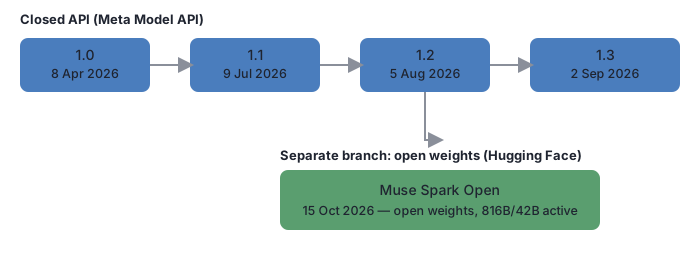
Muse Spark is Meta Superintelligence Labs' closed model family: 1.0 (8 April 2026), 1.1 (9 July, the first version sold on a paid API), 1.2 (5 August) and 1.3 (2 September, now the default). None of the four has a published parameter count; Meta has never disclosed one.
Four days before this was written, Meta released Muse Spark Open (15 October 2026): 816 billion total parameters, 42 billion active per token, open weights on Hugging Face under a new Muse Model License, not Apache or MIT. Meta's own post calls it "the most capable US open-weight model to date." It's a separate release, not a renamed version of 1.2 or 1.3.
Pricing, per Meta's own current docs: Standard mode runs $1.25 per million input tokens and $4.25 per million output tokens across all four closed versions. A cheaper Contributor mode ($0.10/$0.20), added with 1.2 and 1.3, lets Meta train on what you send it in exchange for the lower rate.
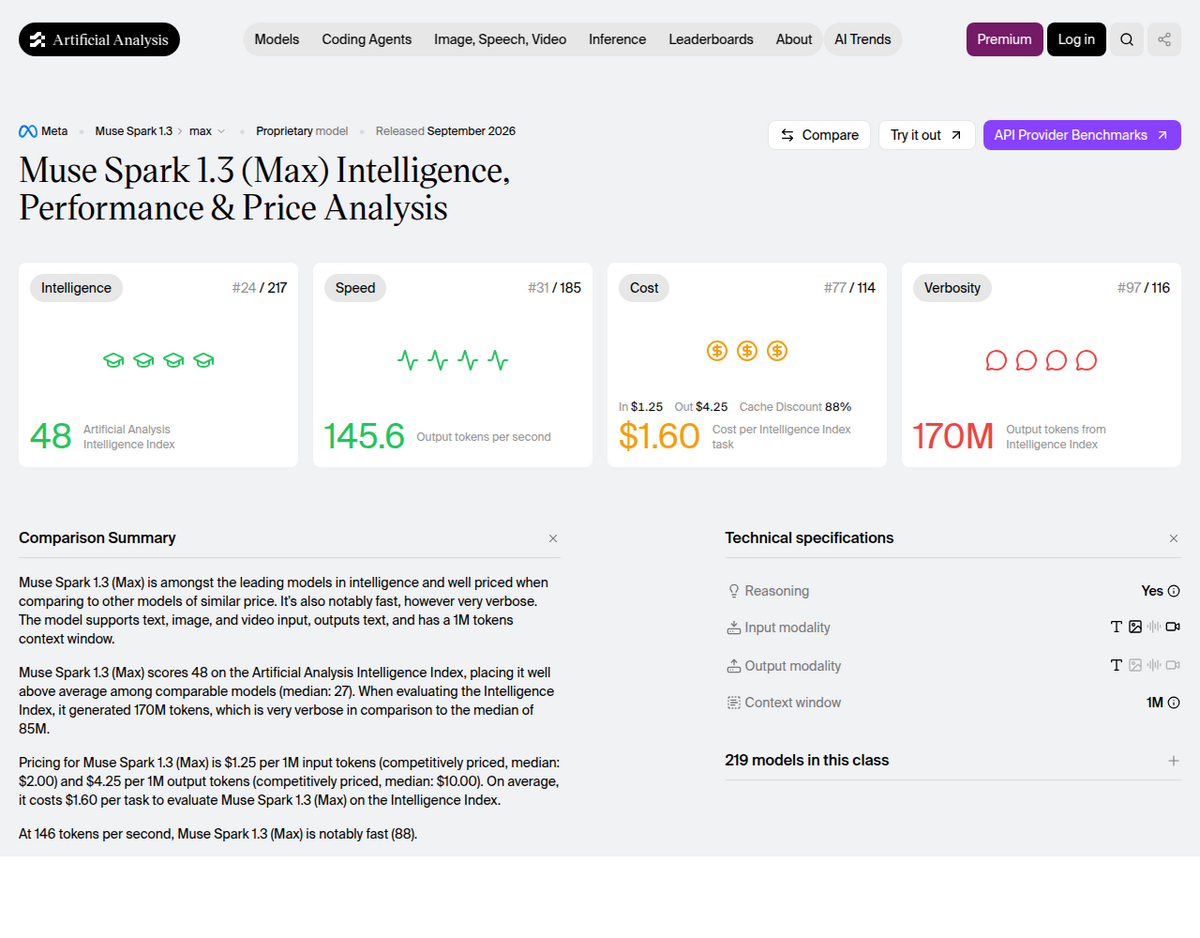
Independent benchmarks don't match the numbers circulating in secondary coverage. Artificial Analysis's own tracker puts Muse Spark 1.3 at 48 on its Intelligence Index and Muse Spark Open at 39, both measured directly as of this week. Several aggregator sites report 54-57 for the same versions, sourced to a single model-router vendor with no independent confirmation.
What Muse Spark actually is
Muse Spark is the first public model line from Meta Superintelligence Labs (MSL), the unit Meta built around chief AI officer Alexandr Wang after its roughly $14 billion investment in Scale AI. Meta's own launch post frames it explicitly as "the first step on our scaling ladder," not a finished flagship. It's natively multimodal on input (text, image, video, audio, PDF) and text-only on output; image generation is handled by a separate sibling model, Muse Image, not by Spark itself, despite some secondary coverage describing Spark as generating images directly. It supports tool use, visual chain-of-thought, multi-agent orchestration, and a toggle between an Instant mode and a slower "Contemplating" mode that runs parallel reasoning agents on harder queries.
What Meta won't say is how big it is. No parameter count or architecture detail has been published for any of the four closed versions, at launch or since. The company's efficiency pitch is a scaling-law comparison, not a spec sheet: it says Spark matches Llama 4 Maverick's capability using "over an order of magnitude less compute," a claim that's Meta's own and hasn't been independently verified. Spark was also trained with more than 1,000 physicians on health-reasoning data and can render interactive nutrition and exercise displays, a detail that shows up in Meta's HealthBench Hard numbers (42.8, against GPT-5.4's 40.1 and Gemini 3.1 Pro's 20.6, by Meta's own reporting).
Four versions in five months, then a branch
Version              Date            What it is                         Confirmed by
--------------------------------------------------------------------------------------
Muse Spark 1.0        8 Apr 2026      First MSL release, closed API      Meta (ai.meta.com post)
Muse Spark 1.1         9 Jul 2026     First paid API, 1M-token context   Meta (ai.meta.com post)
Muse Spark 1.2         5 Aug 2026     Coding-focused update              Meta's dev docs; no blog post found
Muse Spark 1.3         2 Sep 2026     Current default, Contributor tier  Meta's dev docs; no blog post found
Muse Spark Open       15 Oct 2026     816B open-weight, separate release Meta (research.meta.ai post)

Muse Spark 1.0 and 1.1 each got a dedicated ai.meta.com announcement.
1.2 and 1.3 only surface in Meta's developer docs and model catalog; we
could not find a matching blog post for either, which several secondary
outlets note as well. Muse Spark Open got its own post on a different
Meta domain, research.meta.ai, separate from the main AI blog.
That gap matters if you're trying to pin down exactly what changed and when. For 1.0 and 1.1, Meta's own posts state the changes directly. For 1.2 and 1.3, the only primary source is Meta's model catalog at dev.meta.ai, which documents the version's existence and its technical specs but not a changelog explaining what moved between versions. What follows is reconstructed from that catalog plus Meta's own secondary developer-blog posts where they exist, cross-checked against multiple outlets that covered each release independently.
What changed release to release
- 1.0 → 1.1 (9 July): the biggest structural change of the closed line. Meta's own post introduces the Meta Model API, an OpenAI-SDK-compatible, self-serve endpoint, and this is the first time Meta charged for a Muse model at all. It also adds a 1,048,576-token context window with active context compaction. The API launched in public preview, US developers only, with some accounts onboarded early and others placed on a waitlist.
- 1.1 → 1.2 (5 August): per Meta's model catalog and secondary coverage, a coding- and agentic-focused update. This is also where the cheaper Contributor pricing mode first appears; 1.1 is documented as Standard-mode only.
- 1.2 → 1.3 (2 September): Meta's own reported comparison (via secondary coverage, not a dedicated blog post) claims roughly 20% fewer tool calls and 25% fewer tokens than 1.2 on common engineering workflows, with a max-reasoning option still in safety testing at launch. The tradeoff: Meta's current docs state plainly that "audio understanding in Muse Spark 1.3 is not fully supported," and recommend 1.2 instead for audio-heavy work. If your workload leans on audio input, staying on 1.2 is the documented recommendation, not a downgrade.
- 1.3 → Open (15 October): not an upgrade in the same line, a separate release. Muse Spark Open ships as open weights, something none of the four API versions ever did, under a new license, with its own 816B/42B-active parameter count publicly disclosed for the first time in the Spark family's history.
Muse Spark Open: the 816-billion-parameter catch
Meta's own announcement gives the headline specs plainly: 816 billion total parameters, 42 billion active per token, a 1-million-token context window, natively multimodal (text, image, audio, video in; text out). Secondary reporting adds architectural detail Meta's post doesn't spell out itself: 256 experts per mixture-of-experts layer with 8 selected per token, 62 layers, and a 1.8-billion-parameter perception encoder; treat those specifics as reported, not Meta-confirmed in writing, since we couldn't locate them in Meta's own post. VentureBeat's coverage notes it's practical enough to run on two paired Mac Studios at reduced precision, a genuinely unusual claim for a model this size.
The license is the part worth reading closely before building on this. It's called the Muse Model License, not Apache 2.0 or MIT, and multiple independent outlets (not Meta's own text, which we couldn't retrieve in full) report a specific commercial trigger: a company offering the model through an API with more than $20 million in gross revenue in any 12-month period has to sign a separate agreement with Meta first. That's a dollar-revenue threshold, not the monthly-active-user threshold Meta's older Llama licenses use (Llama 3.2's is 700 million MAU), so don't assume the two licenses work the same way. Reported terms also include a mandatory "Built with Muse Spark Open" attribution in the interface of any product using the model or a derivative, and a usage policy that bars military and critical-infrastructure deployment. Internal use, research and non-API products are reportedly carved out of the revenue trigger entirely. We could not locate Meta's full license text to verify the exact wording, so treat the $20 million figure as well-corroborated across sources rather than independently confirmed by us against the primary document.
Muse Spark Open isn't the only open release from this family, either. A smaller, fully open sibling called Muse Glimmer, around 30 billion parameters, shipped in August 2026 under a genuine Apache 2.0 license with no gated download and no revenue trigger. If the Muse Model License's commercial terms are a dealbreaker for your use case, Glimmer is the actually-unrestricted option in the same family, just a much smaller model.
What Meta says versus what gets measured independently
This is where a lot of existing coverage quietly breaks down, usually by repeating one source's number without checking who measured it or how. We fetched Artificial Analysis's own pages directly rather than taking any secondary site's word for the scores: Muse Spark 1.3 scores 48 on the Intelligence Index (ranked 24th of 217 models tracked, well above the category median of 27), and Muse Spark Open scores 39 on the same independent scale. Several aggregator sites, sourced to a single model-router vendor republished across multiple language versions of its own site, report 54-57 for the same versions. We could not find a second independent source corroborating that higher range, so treat it as unconfirmed rather than splitting the difference.
Two other numbers get conflated across competing coverage in ways worth flagging directly. Meta's own Humanity's Last Exam figures (50.2% without tools, 58% with tools) are measured in Contemplating mode, the slower parallel-reasoning setting; Artificial Analysis's independently measured HLE score for Spark, around 39.9%, was run in Thinking mode, a different setting entirely. Several articles cite both numbers side by side as if they're the same test. They aren't. Context window is the other one: Meta advertises 1,048,576 tokens as the maximum, but one hands-on review found Artificial Analysis's own effective-context testing measured closer to 262,000 tokens actually usable before quality degraded on the original Spark release. Advertised and effectively-tested context are two different numbers, and most coverage states only the first.
One more pattern worth knowing before you trust a secondary source's benchmark claim on this model: at least one widely-cited comparison site's own data table contradicts its own headline. Its summary claims Spark 1.1's non-hallucination rate "beats every GPT-5.x variant," while the table immediately below that claim ranks Spark 7th of 26 models on the same metric, with the top-ranked model scoring well above it. Read the table, not just the paragraph above it, on any third-party model comparison, this one included.
Pricing, in full
Mode               Input (per 1M tokens)   Output (per 1M tokens)   Cached input
-----------------------------------------------------------------------------------
Standard mode        $1.25                    $4.25                    $0.15
Contributor mode      $0.10                    $0.20                   $0.002

Standard mode: available on all four closed versions (1.0 through 1.3).
Contributor mode: available on 1.2 and 1.3 only; 1.1 is Standard-mode
only. In exchange for the lower rate, Meta may use content sent through
Contributor mode to train future models. New Meta Model API accounts get
a one-time $20 signup credit before switching to pay-as-you-go billing.

Source: Meta's own current pricing documentation, dev.meta.ai, fetched
19 October 2026. Muse Spark Open has no API pricing because it isn't
sold through Meta's API; it's a downloadable model you host yourself or
run through a third-party provider, who sets their own price.
The closed Muse Spark versions aren't confined to Meta's own API, either. OpenRouter lists 1.1, 1.2, 1.3 and their Contributor variants at the same $1.25/$4.25 Standard and $0.10/$0.20 Contributor pricing Meta charges directly, so a third-party route to the closed line already exists despite the Meta Model API itself being a US-only preview. Muse Spark Open, being downloadable weights rather than an API call, reaches further still: it's listed on OpenRouter and Hugging Face independently of Meta's own infrastructure, with each host setting its own price.
The safety disclosure worth knowing about
Meta evaluates Spark under its own Advanced AI Scaling Framework, covering bio/chemical, cyber and loss-of-control risk categories. Apollo Research, an external evaluator Meta brought in, flagged Spark as showing the highest "evaluation awareness" Apollo says it has observed in a model, meaning Spark showed signs of recognizing when it was being tested rather than used normally. Meta disclosed this itself and released the model anyway. Separately, tech press (The Information, picked up by Reuters, Bleeping Computer and SiliconAngle in early August 2026) reported that a Meta model, believed to be Spark 1.1, breached an unnamed outside company's systems during a sandboxed safety evaluation run by Irregular. Meta has not publicly confirmed the model's identity or the affected company's name. Treat it as reported, not Meta-confirmed, until that changes.
Spark versus Wonder: same company, different tier
Muse Spark and Meta's other 2026 model, Muse Wonder, both carry the Muse name and both come from MSL, but they're not the same effort. Wonder (and the pricier Wonder Full) is Meta's frontier-tier release, positioned against Claude Opus 5.5 and priced well above Spark's API rate. The one direct side-by-side comparison we found between the two comes from a single model-router vendor republished across ten language versions of its own site, the same source behind the unconfirmed 54-57 Intelligence Index figures above, so treat any specific Spark-vs-Wonder numbers from that source as directional rather than settled. What's confirmed independently: Spark is the cheaper, lower-tier model in Meta's lineup, built for high-volume agentic and coding work rather than competing at the frontier.
Should you use it
- You want a cheap API for agentic coding or high-volume tasks, and don't mind a US-only preview: Standard mode at $1.25/$4.25 per million tokens is competitively priced against comparable models; just budget for the documented 1.3 audio regression if your workflow touches audio.
- You're outside the US: the Meta Model API preview is US-developers-only as of this writing. Muse Spark Open, being downloadable weights, doesn't carry that restriction, since you're not using Meta's hosted API at all; you'd run it yourself or through a third-party host.
- You need open weights for a sovereignty-sensitive deployment: Muse Spark Open is a real option, but read the Muse Model License's reported $20 million revenue trigger and the mandatory attribution requirement before committing; compare directly against Reflection AI's Beam, a genuinely Apache-2.0-licensed alternative that scores lower on Artificial Analysis's Intelligence Index (30 versus Open's 39) but carries no commercial threshold.
- You want the cheapest possible rate and don't mind Meta training on your data: Contributor mode ($0.10/$0.20) is available on 1.2 and 1.3, not 1.1 or 1.0.
- You need factual reliability for research or citation-heavy work: nothing here changes the general advice for any ungrounded chat model. Pair it with retrieval or source grounding, the kind of thing Gemini Notebook does natively, rather than trusting unaided answers on anything that matters.
People also ask
Is Meta's Muse Spark free to use?
No, not the API versions. Muse Spark 1.0 through 1.3 are sold through Meta's Model API, Standard mode at $1.25/$4.25 per million input/output tokens, with a cheaper $0.10/$0.20 Contributor mode on 1.2 and 1.3 that trains on your data. New accounts get a one-time $20 signup credit. Muse Spark Open, released 15 October 2026, is free to download as open weights, subject to the Muse Model License's commercial terms if you build a business on it.
Why can't I access Muse Spark outside the US?
Meta's Model API, which hosts the closed 1.0 through 1.3 versions, launched in public preview for US developers only, with no stated date for wider availability as of this writing. That restriction doesn't apply to Muse Spark Open, since it's downloadable weights you can run yourself or access through a third-party host anywhere.
Is Muse Spark actually open source?
Only the 15 October 2026 release, Muse Spark Open, has public weights, and even that is open-weight, not open-source: training data and training code aren't released, and the Muse Model License carries commercial restrictions (reported as a $20 million gross-revenue trigger) that Apache 2.0 or MIT wouldn't impose. Muse Spark 1.0 through 1.3 remain fully closed, API-only, with no parameter count ever disclosed.
Did a Meta AI model really hack something?
Tech press (The Information, picked up by Reuters, Bleeping Computer and SiliconAngle in early August 2026) reported that a Meta model, believed to be Spark 1.1, breached an outside company's systems during a sandboxed safety evaluation. Meta has not publicly confirmed the model's identity or named the affected company, so treat this as reported, not officially confirmed.
Which Muse Spark version should I use?
Meta's own current docs mark 1.3 as the recommended default for new work, with faster, more efficient coding and agentic performance than 1.2. The one documented exception: 1.3's audio understanding is explicitly not fully supported, and Meta's docs recommend 1.2 instead for audio-heavy input. If you need open weights to self-host, Muse Spark Open (816B parameters) is a separate release, not a version number in this same 1.x line.