GPT-6 Luna, explained: OpenAI's cheapest model, and the one most free users are already talking to
GPT-6 Luna launched quietly on 22 September 2026, a side note next to GPT-6 Astra's flagship debut 19 days earlier. Then, on 8 October, it became the model running every free and Go-tier ChatGPT conversation with the new Intelligent UI. Here's what it actually is, what it costs, how it benchmarks, and how to keep it straight from Sol, Astra, and GPT-6.1 Sol.
GPT-6 Luna is OpenAI's efficiency-tier GPT-6 model, launched 22 September 2026 alongside the mid-tier GPT-6 Sol, three weeks after the flagship GPT-6 Astra. OpenAI's own API docs describe it only as "our most efficient model for focused, high-volume tasks," with no disclosed parameter count or architecture detail.
It's the cheapest model in the GPT-6 family by a wide margin: $0.10 per million input tokens and $0.50 per million output tokens, roughly 20 times cheaper than GPT-6 Sol ($2 / $10) on both ends, confirmed directly against OpenAI's developer docs.
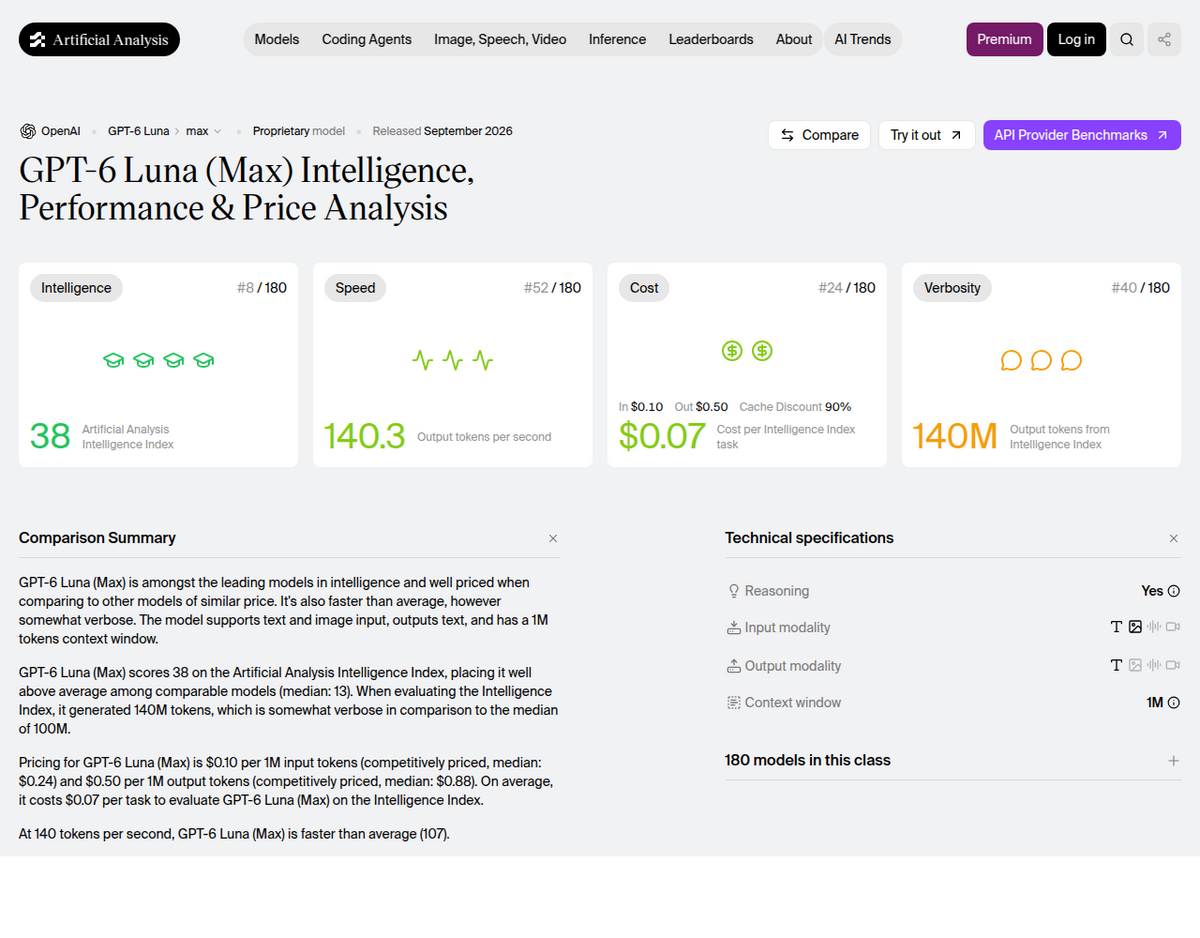
It scores surprisingly well for its price. Artificial Analysis puts GPT-6 Luna (Max effort) at 38 on its Intelligence Index, ranked #8 of 180 tracked models and well above the comparison set's median of 13, while costing a fraction of most models ranked near it.
You're probably already using it without choosing to. Since 8 October 2026, every ChatGPT Free and Go account's Chat tab runs on GPT-6 Luna by default, as the model behind OpenAI's new Intelligent UI rollout. Paid Plus/Pro/Business/Enterprise accounts run GPT-6 Sol instead.
What GPT-6 Luna actually is
OpenAI is unusually quiet about what's actually inside GPT-6 Luna. Its own API documentation describes it with a single line, "our most efficient model for focused, high-volume tasks," and lists no parameter count, no architecture family, and no distillation lineage. That's consistent with how OpenAI has described efficiency-tier models since the GPT-5 era: the marketing framing is speed and cost, not technical specifics, and nothing in the current docs suggests that's changed for GPT-6.
What is documented, directly from OpenAI's model page: a 1,050,000-token context window, a maximum input of 922,000 tokens, a maximum output of 128,000 tokens, text and image input with text-only output, and a knowledge cutoff of 18 May 2026. Reasoning effort is adjustable across six levels, none, low, medium (the default), high, xhigh, and max, which matters for both quality and cost: every benchmark in this article, including the Artificial Analysis numbers above, is measured at the max effort setting, not the default. Luna run at its default medium effort will likely score lower and cost less than the max-effort figures quoted here and elsewhere; OpenAI's docs don't publish a separate benchmark for the default setting.
Where Luna sits in OpenAI's GPT-6 lineup
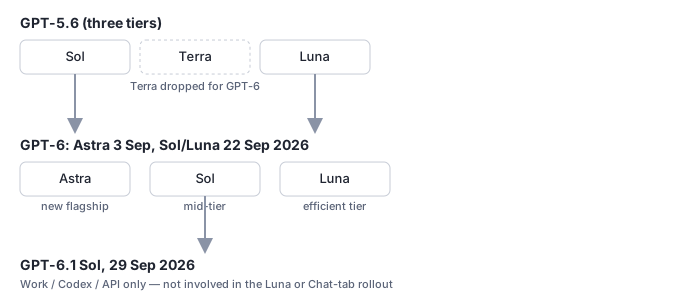
The naming is genuinely confusing, and OpenAI hasn't published anything that walks through it directly, so here's the full lineage. GPT-5.6 shipped with three tiers: Sol, Terra, and Luna. GPT-6, launched 3 September 2026, restructured that into a different three: Astra as the new flagship ("continues to be our best model across the board," per OpenAI), Sol demoted to a mid-tier position it didn't previously hold, and Luna kept as the efficiency tier, though a materially different model than GPT-5.6 Luna under the same name. Terra was dropped entirely; OpenAI hasn't stated why. Then, a week after Sol and Luna shipped, GPT-6.1 Sol launched on 29 September 2026 at DevDay as a separate, incremental upgrade to Sol specifically, available only in Work, Codex, and the API. GPT-6.1 Sol has no Luna counterpart as of this writing, and it played no role in the Chat-tab rollout described below; see our GPT-6.1 Sol explainer for that model specifically.
Pricing, confirmed against OpenAI's own docs
Metric                    Price              Note
--------------------------------------------------------------------
Input                      $0.10 / 1M tokens
Cached input                $0.01 / 1M tokens   10% of uncached rate
Cache writes                $0.125 / 1M tokens  1.25x uncached rate
Output                      $0.50 / 1M tokens
Prompts over 272K input     2x input/cache,      Full request repriced
                             1.5x output
Batch / Flex                50% of standard rates
Fast mode                   2x standard rates
Regional processing         +10% premium         Where available

Confirmed directly against developers.openai.com/api/docs/models/gpt-6-luna,
12 October 2026.
For comparison, GPT-6 Sol is priced at $2 per million input tokens and $10 per million output tokens, confirmed directly against OpenAI's own docs the same way as Luna's numbers above. That makes Luna roughly 20 times cheaper than Sol on both input and output. GPT-6 Astra, the flagship, is pricier again: $10 input / $50 output per million tokens, making Astra 100 times Luna's output price and 5 times Sol's. OpenAI has described the Sol/Luna generational jump only as "about half the price" of their GPT-5.6 equivalents, a framing about year-over-year pricing, not the gap between tiers in the current lineup, which is what the numbers above actually show.
A concrete comparison: processing a 300-page research PDF (roughly 150,000 tokens) and getting back a 2,000-word summary (roughly 2,700 tokens) costs about $0.016 on Luna, $0.33 on Sol, and $1.64 on Astra, uncached, at list price. Luna's cost advantage holds up for exactly the kind of high-volume document work this comparison implies, run the same job a thousand times and the gap between $16 and $1,640 is the entire reason the three-tier pricing structure exists.
How it performs, independently measured
Artificial Analysis, which runs OpenAI's models through its own standardized Intelligence Index rather than relying on vendor-reported scores, puts GPT-6 Luna (Max effort) at 38, ranking #8 of 180 models it tracks, against a comparison-set median of 13. That's a genuinely strong result for a model priced at $0.10/$0.50 per million tokens: Luna's cost-per-Intelligence-Index-task works out to $0.07, and its blended rate (assuming a realistic 7:2:1 cache-hit-to-input-to-output ratio) comes to $0.08 per million tokens.
Two numbers worth knowing before you lean on Luna for a latency- or length-sensitive workload: its output speed measured at 140.3 tokens per second, only middling at #52 of 180 tracked models (the comparison median is 107.1, so it's faster than average, just not fast for its price class), and its verbosity, 140 million output tokens generated across the full Intelligence Index evaluation, which Artificial Analysis flags as "somewhat verbose" against a 100M-token median. In practice: Luna tends to write longer responses than necessary to reach a given answer, which works against you on a per-token-billed API plan even though the per-token price itself is low.
GPT-6 Luna vs. Sol vs. Astra vs. GPT-6.1 Sol
Model          Launched      Intelligence Index   Price (in/out,     Where you'll
                              (Artificial            per 1M tokens)    find it
                              Analysis, Max effort)
-------------------------------------------------------------------------------------
GPT-6 Astra    3 Sep 2026    53 (#7 of 227)         $10 / $50          Work, Codex,
                                                                         API; flagship
                                                                         everywhere
GPT-6 Sol      22 Sep 2026   48 (#25 of 227);       $2 / $10           Work, Codex,
                              Artificial Analysis                       API; Chat tab
                              lists it deprecated                       (paid plans)
                              in favor of 6.1 Sol                       from 7 Oct
GPT-6.1 Sol    29 Sep 2026   52 (#11 of 227)        $2 / $10,          Work, Codex,
                                                      unchanged          API only
                                                      from Sol
GPT-6 Luna     22 Sep 2026   38 (#8 of 180)         $0.10 / $0.50      Work, Codex,
                                                                         API, desktop
                                                                         app; Chat tab
                                                                         (free/Go) from
                                                                         8 Oct

Luna's Intelligence Index is drawn from a 180-model comparison set rather than
the 227-model set the other three rows use, per Artificial Analysis's own
pages for each model as fetched 12 October 2026; the two sets overlap heavily
but aren't identical, so treat the rank numbers as directionally comparable,
not perfectly apples-to-apples.
Where you'll actually run into GPT-6 Luna
Until 7-8 October, Luna lived almost entirely out of sight: available in Work, Codex, and the API since 22 September, and in the ChatGPT desktop app for Free and Go users, but not in ChatGPT's main Chat tab on web or mobile. That changed when OpenAI extended its new Intelligent UI feature, interactive diagrams and widgets instead of plain text, into regular Chat. Plus, Pro, Business, and Enterprise accounts got GPT-6 Sol with Intelligent UI on 7 October; Free and Go accounts got GPT-6 Luna with the same feature a day later, on 8 October. That rollout is the first time most ordinary ChatGPT users, specifically everyone not paying $20+/month, have had their default Chat-tab model be a GPT-6-generation model at all, rather than a GPT-5.6-era free-tier default.
Practically, if you're on ChatGPT's free tier or the $8/month Go tier (see our ChatGPT Go pricing breakdown for what Go actually includes) and you've noticed your chats rendering diagrams and interactive widgets since early October, GPT-6 Luna is the model doing that work. It carries no separate usage quota of its own: your existing message-count limits for your plan apply the same way they did before Luna replaced whatever model was running your free-tier chats previously.
Should you use Luna directly through the API instead of ChatGPT?
If you're building something, rather than chatting, Luna's case is straightforward: for high-volume, low-complexity work, summarization, extraction, classification, quick drafts, its price-to-Intelligence-Index ratio is hard to beat inside OpenAI's own lineup, and the 1M-token context window means it can ingest a large document or codebase in one call. Where it gets more expensive than the sticker price suggests is verbose output on a metered plan: if your use case generates long responses (open-ended writing, detailed explanations) rather than short structured ones (extracted fields, classifications, brief summaries), the "somewhat verbose" flag from Artificial Analysis means your real per-task cost will run higher than the $0.07 headline figure, since that figure already reflects Luna's above-median token usage, not a best case.
For anything requiring strong reasoning under pressure, debugging a gnarly codebase, multi-step agentic tasks, open-ended research synthesis, Sol, GPT-6.1 Sol, or Astra will do better; that's the reason OpenAI ships more than one tier. The gap is real but narrower than the pricing gap implies: Astra's Intelligence Index (53) beats Luna's (38) by 15 points while costing 100 times as much per output token, and Sol (48) beats Luna by only 10 points at 20 times the price. Luna's Intelligence Index score is strong relative to its own price class; it's a worse trade the harder the task actually is, which is exactly where the higher tiers earn their price.
People also ask
What is GPT-6 Luna?
OpenAI's efficiency-tier GPT-6 model, launched 22 September 2026 alongside GPT-6 Sol, three weeks after flagship GPT-6 Astra. OpenAI describes it only as "our most efficient model for focused, high-volume tasks," with no published parameter count. It has a 1,050,000-token context window and a knowledge cutoff of 18 May 2026.
How much does GPT-6 Luna cost?
$0.10 per million input tokens and $0.50 per million output tokens via the API, confirmed directly against OpenAI's developer documentation. That's roughly 20 times cheaper than GPT-6 Sol ($2/$10 per million tokens) on both input and output.
Is GPT-6 Luna the same model that powers free ChatGPT?
Since 8 October 2026, yes: free and Go-tier ChatGPT accounts run on GPT-6 Luna by default in the Chat tab, as part of OpenAI's Intelligent UI rollout. Paid Plus, Pro, Business, and Enterprise accounts run GPT-6 Sol instead.
How does GPT-6 Luna compare to GPT-6 Sol?
Sol is priced at $2/$10 per million tokens, 20 times Luna's $0.10/$0.50, for an Intelligence Index of 48 versus Luna's 38 (Artificial Analysis, Max effort), a real but narrower gap than the price difference suggests. Both launched 22 September 2026. Artificial Analysis also lists GPT-6 Sol as deprecated in favor of GPT-6.1 Sol, which scores 52 at the same $2/$10 price.
Is GPT-6 Luna the same as GPT-5.6 Luna?
No, despite sharing a name. GPT-5.6 had a three-tier lineup of Sol, Terra, and Luna. GPT-6 restructured this to Astra (new flagship), Sol (mid-tier), and Luna (efficiency tier), dropping Terra entirely. GPT-6 Luna is a different underlying model from GPT-5.6 Luna, just reusing the same tier name.
Xuất NotebookLM của bạn chỉ với một cú nhấp
Tiện ích Chrome miễn phí. PDF, Word và Markdown. Kết xuất trên máy của bạn — không tải gì lên.