NotebookLM vs ChatGPT: which one should you actually use?
This is not really a competition. One tool answers from what you give it and shows its work; the other answers from everything it learned and does not. Picking wrong for the task is the actual risk, not picking the weaker tool.
NotebookLM was renamed Gemini Notebook in July 2026. This guide covers the same product under its new name — everything below still applies whether you know it as NotebookLM or Gemini Notebook.
Use NotebookLM when the answer needs to come from specific documents you trust and you need to verify where a claim came from. Use ChatGPT for open-ended writing, brainstorming, and questions where the answer legitimately draws on general knowledge rather than a fixed set of sources.
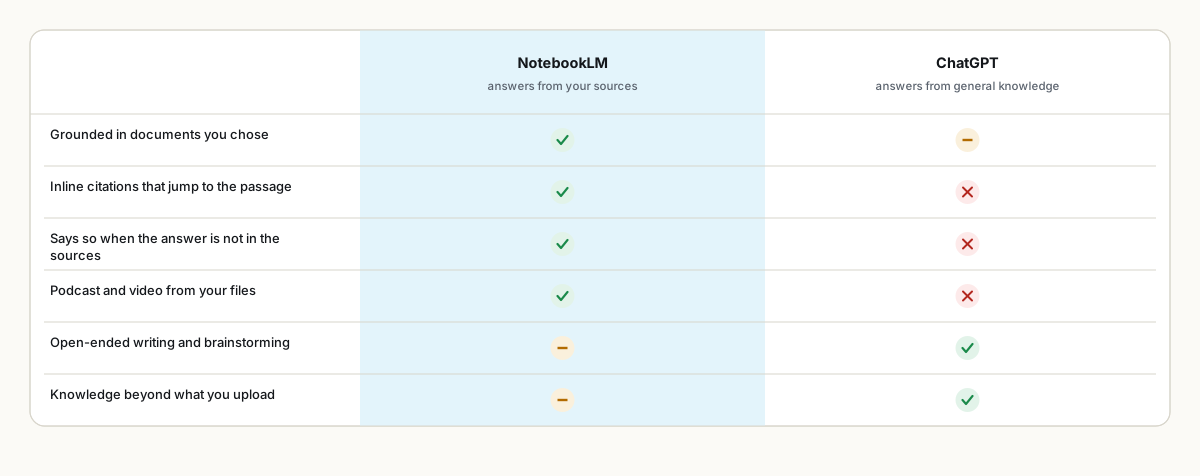
The one real difference
ChatGPT answers primarily from what it learned during training, plus whatever you paste into the conversation. NotebookLM answers from the documents you explicitly uploaded, full stop, and each claim carries a citation pointing at the exact passage. That single design choice explains every entry in the comparison below; nothing else about the two products actually diverges that much.
Where NotebookLM wins
- Research over your own material. Papers, contracts, meeting transcripts, course readings: anything where the answer must trace back to a specific document.
- Verifiable claims. Citations you can click and check turn "trust me" into "see for yourself," which matters for anything you plan to reuse professionally.
- Turning documents into other formats. Audio Overviews, mind maps, study guides and flashcards generated from your own sources have no equivalent in ChatGPT.
- Saying "I don't know." A grounded model that admits a gap is more useful than a fluent one that fills it with a plausible guess.
Where ChatGPT wins
- Open-ended writing and brainstorming, where you want ideas that go beyond what any document already contains.
- General knowledge questions with no fixed source to point at, the kind a search engine or an expert would answer from memory.
- Iterative creative work, drafting, revising and rewriting text in a back-and-forth conversation.
- Broader tool integration and coding assistance, an area NotebookLM does not attempt to compete in.
A test that settles most cases
Ask yourself: could I hand a person the same set of documents and expect a correct answer purely from reading them? If yes, that is a NotebookLM question. If the honest answer requires knowledge beyond any specific document you would hand over, that is a ChatGPT question. Most confusion about which tool to use comes from skipping this test.
They are not actually rivals
A workflow that uses both: collect and verify facts in NotebookLM, where citations keep you honest, then take the verified synthesis into ChatGPT (or any general assistant) for the open-ended drafting, brainstorming or polishing that follows. NotebookLM stays the fact layer; the general assistant stays the creative layer. Neither tool is trying to replace the other, whatever the marketing implies.
FAQ
Is NotebookLM more accurate than ChatGPT?
For questions about documents you upload, generally yes, because answers are grounded and cited. For general knowledge questions with no specific source, the comparison doesn't really apply the same way.
Can NotebookLM replace ChatGPT for everyday use?
Not for open-ended writing, brainstorming or general questions; those are not what it's built for. It excels specifically at question-answering and synthesis over documents you provide.
Which one has better citations?
NotebookLM's citations are the core of the product: every claim links to the source passage it came from. ChatGPT does not work this way by default.
Is NotebookLM the same as Gemini Notebook?
Yes. Google renamed NotebookLM to Gemini Notebook in July 2026 — it's the same product, same features, just a new name.
Експортуйте свій NotebookLM в один клік
Безкоштовне розширення Chrome. PDF, Word і Markdown. Обробка на вашому пристрої — нічого не завантажується в мережу.