Mistral raised $3.5 billion this week for a chatbot called Le Chat. It hasn't been called that since May
On 8 September 2026, Mistral AI closed a €3 billion (~$3.5B) round led by Samsung, valuing the French company at over €21 billion and making it the largest funding round ever closed by a European tech company. Nearly every wire report called the product "Le Chat." Mistral renamed it Vibe on 28 May 2026, over three months earlier. That's not the only gap between the funding story and what Mistral actually ships: the round is being framed as European AI sovereignty, and its own flagship data center runs on 13,800 Nvidia GPUs.
Mistral raised €3 billion (~$3.5B) on 8 September 2026, led by Samsung Electronics with Scaleup Europe Fund (EQT) and PSG Equity, at a post-money valuation over €21 billion (reported as ~$24B), nearly double last year's €11.7B Series C.
"Le Chat" stopped being the product's name on 28 May 2026. It's now called Vibe, with three modes: Vibe Chat (the old turn-based conversation), Vibe Work (agentic, multi-step tasks across 100+ connected tools), and Vibe Code (a CLI, VS Code extension, and web coding assistant). Same login, same chat.mistral.ai URL.
Vibe Pro costs $14.99/month, undercutting ChatGPT Plus ($20), Claude Pro (roughly $17-20), and Google AI Pro (roughly $19.99). Google does have a cheaper entry tier, Google AI Plus (around $4.99/mo), so Vibe isn't the cheapest paid AI subscription available anywhere, just the cheapest among the flagship all-in-one tiers.
The "sovereign AI" framing has a real gap: Mistral's own data centers run on Nvidia hardware (13,800 GB300 GPUs at its Bruyères-le-Châtel site alone), and Samsung, this round's lead investor, is itself a hardware supplier. "Sovereignty" here means EU data residency and regulatory compliance, not hardware independence.
The round, in numbers
Samsung Electronics led the €3 billion Series D, with Scaleup Europe Fund (a public EQT-managed vehicle) and existing investor PSG Equity co-leading. New names joining the cap table include Advent, funds managed by BlackRock, and the Grand Duchy of Luxembourg. The post-money valuation lands above €21 billion, roughly double the €11.7 billion mark set a year earlier when ASML led Mistral's Series C. Bloomberg, CNBC, and TechCrunch all confirmed the figures independently on 8 September, so the round itself isn't in question. What's worth checking is what it's being used for and what it's being called while it happens.
Some of that capital is already committed: Mistral raised $830 million in debt earlier in 2026 to build a data center at Bruyères-le-Châtel, outside Paris, running 13,800 Nvidia GB300 GPUs, and has a second, €1.2 billion facility under development in Sweden. Combined, Mistral is targeting 200 megawatts of European compute capacity by the end of 2027.
The product got renamed three months ago, and most of this week's coverage missed it
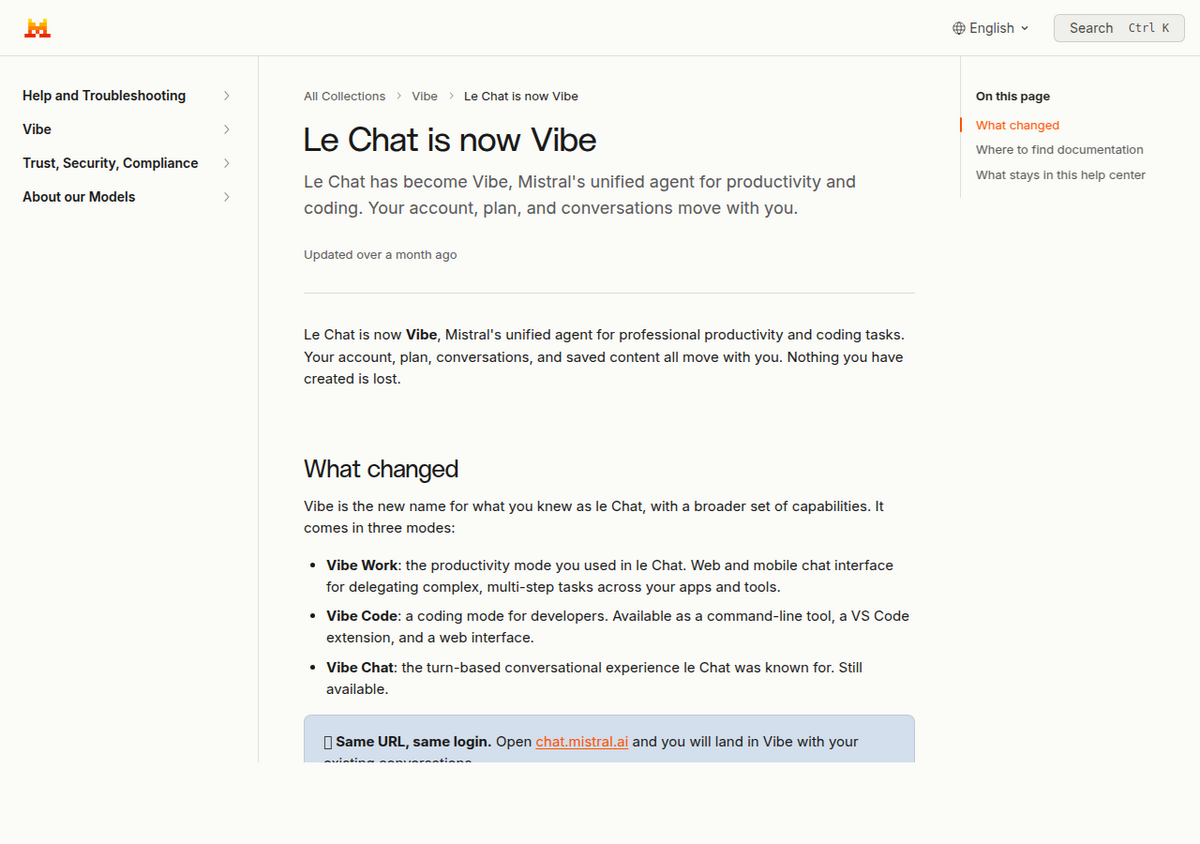
Mistral's help center states it plainly: "Le Chat has become Vibe, Mistral's unified agent for professional productivity and coding tasks. Your account, plan, conversations, and saved content all move with you." The rename happened on 28 May 2026, and Vibe now ships in three modes rather than one: Vibe Chat is the same turn-based conversation Le Chat always was, still available. Vibe Work is a new agentic layer that delegates multi-step tasks across more than 100 connected tools, including email, calendar, Slack, GitHub, and Jira. Vibe Code merges what used to be separate coding tools into a command-line tool, a VS Code extension, and a web interface. Google's own Play Store listing confirms the rename is fully rolled out, titling the Android app "Vibe by Mistral (ex-Le Chat)." If you tried Le Chat months ago and moved on, what exists today under the old URL is a materially different, more capable product.
What Vibe actually offers you right now
Pricing, verified against Mistral's own pricing page and cross-checked against independent write-ups:
Tier         Price               What you get
------------------------------------------------------------------------
Free         $0                  Limited messages/searches, $10/mo API
                                  credit, throttled image gen, 100+
                                  connectors, basic document upload
Pro          $14.99/mo           More messages, all-day coding across
             ($5.99-6.99/mo        CLI/IDE/web, $15/mo API credit,
              for students)        up to 15GB document storage,
                                  task scheduling
Team         $24.99/user/mo      Everything in Pro + 30GB/user storage,
             ($19.99 annual)       domain verification, audit logs
Enterprise   Custom              Custom models/agents, SAML SSO,
                                  white-label, on-prem deployment
One caveat worth flagging: Mistral doesn't publish exact free-vs-Pro message or image-generation quotas the way some competitors do, so "limited" is as precise as its own documentation gets. What is concretely useful, and independently confirmed by a hands-on review from XDA-Developers, is that Vibe's agentic Work-mode features, multi-tab canvas editing, and scheduled recurring tasks are available on the free tier, while the equivalent features are paywalled on ChatGPT (Tasks), Gemini (Scheduled Actions), and Claude (scheduled tasks require Cowork or a paid plan).
For anyone reading this site specifically for source-grounded document work: Vibe added a feature called Libraries that functions as Mistral's answer to Gemini Notebook/NotebookLM. It's a persistent, cross-session knowledge base, not a single-chat upload, supporting up to 100 files per library at 100MB each, with real-time retrieval and numbered footnotes linking answers back to source passages, close to NotebookLM's own citation model. Mistral's documentation doesn't state which tier gates Libraries, so confirm your own access before planning around it. It's a genuine capability, not a marketing claim: file-count and per-file limits are specific and checkable, and the footnote-citation mechanic is the single most NotebookLM-like feature in Vibe today. It's still positioned by every independent comparison we found as the cheapest capable option in its class, not the deepest one: Gemini keeps the largest context windows and the tightest Workspace integration, and Claude and ChatGPT are generally rated ahead of it on long-document and code-heavy work.
The sovereignty claim, and what it actually covers
Mistral and its investors are framing this round around European AI sovereignty, and part of that claim is real and verifiable: Mistral's API defaults to EU data residency, it publishes an explicit GDPR data-processing addendum naming itself as the data processor, and its Enterprise tier offers actual on-premises or private-cloud deployment, an option none of ChatGPT, Gemini, or Claude currently offer at the frontier-model level. As a France-incorporated company, GDPR applies to Mistral natively, not through the kind of adequacy bridge U.S. competitors' EU operations rely on.
What that claim doesn't cover is hardware. Mistral's flagship Bruyères-le-Châtel site runs on 13,800 Nvidia GB300 GPUs; a second site, operated with Scaleway, adds roughly 18,000 more Nvidia GB200 GPUs. The clearest evidence of the tension sits in Mistral's own investor list for this exact round: Nvidia is a returning investor in the €3 billion raise, alongside a16z, ASML, General Catalyst, Lightspeed, and Salesforce Ventures, meaning the company whose chips physically run Mistral's data centers is also financing the round being marketed as European AI independence. A Yahoo Finance/Forkast analysis published alongside the funding news put it plainly: "the foundation of European AI sovereignty is built on US-owned silicon," describing a "persistent dependency paradox" between the sovereignty pitch and the underlying supply chain. European public capital (Scaleup Europe Fund is a public, EQT-managed vehicle) and defense contracts with the French and Luxembourg militaries are embedding Mistral into national-security infrastructure that still runs on non-European chips. "Sovereign" here means data residency and regulatory control, not independence from the same GPU supply chain every other AI lab depends on. That's a real distinction worth knowing if data sovereignty is specifically why you'd choose Mistral over a U.S. competitor: you're getting EU-controlled data handling, not EU-built infrastructure.
Does the valuation add up?
Mistral's CFO has said the company is on track for $1 billion in annual recurring revenue by the end of 2026, up from a reported ~$400 million in January 2026 and roughly $16 million at the end of 2024, a genuine ~20x-in-a-year growth curve for a startup. At $400M ARR, a valuation of roughly $23-24B implies a revenue multiple in the 57-60x range. For scale, Anthropic's run rate had reached roughly $65 billion by the end of July 2026 and OpenAI's had topped $40 billion by mid-August 2026: Mistral's total revenue is smaller than what either U.S. lab adds in a single quarter, even as its valuation gets compared to theirs in headlines. Its enterprise revenue also leans on a small number of very large, multi-year contracts rather than broad usage growth, a concentration risk worth knowing about if you're evaluating Mistral as a long-term platform bet rather than just a cheaper subscription. None of this makes the round fake or the company weak; it does mean "Europe's sovereign AI champion" is currently a much smaller business than the OpenAI/Anthropic comparisons in this week's coverage imply.
Should you actually switch to Vibe?
If price is your deciding factor and you want agentic task automation without paying extra for it, Vibe's free tier already includes features ChatGPT, Gemini, and Claude gate behind a subscription, and its $14.99 Pro tier undercuts all three flagship competitors. If you're doing serious document research across a large, growing source collection, Libraries is a real, citation-backed feature worth testing, but it's new enough (file-count limits stated, tier-gating not yet documented anywhere) that you should verify your own access and limits directly in the product rather than assume parity with Gemini Notebook's more mature source-management tools. If EU data residency specifically is your reason for choosing a European provider, Mistral's data-handling and GDPR posture are real and worth the switch; just don't mistake that for independence from the same Nvidia-built infrastructure every other lab in this comparison runs on.
People also ask
Is Le Chat still called Le Chat?
No. Mistral renamed it Vibe on 28 May 2026. It kept the same login and the same chat.mistral.ai URL, and existing accounts, plans, and conversation history carried over automatically. "Le Chat" now refers to Vibe Chat, one of Vibe's three modes (Chat, Work, Code).
How much did Mistral raise, and what is it worth?
Mistral closed a €3 billion (~$3.5B) Series D on 8 September 2026, led by Samsung Electronics, at a post-money valuation above €21 billion (reported around $24B), roughly double its €11.7 billion valuation from a year earlier.
Is Mistral Vibe actually a sovereign, independent European AI?
Its data handling is genuinely EU-controlled: EU data residency by default, a published GDPR data-processing addendum, and on-premises deployment options for Enterprise customers. Its compute infrastructure is not independent of the same global supply chain as its competitors: its flagship data center runs on roughly 13,800 Nvidia GPUs, and Nvidia is itself a returning investor in this exact funding round.
How much does Mistral Vibe cost compared to ChatGPT, Gemini, and Claude?
Vibe Pro is $14.99/month, cheaper than ChatGPT Plus ($20), Claude Pro (roughly $17-20), and Google AI Pro (roughly $19.99), though Google's cheaper Google AI Plus tier (around $4.99/mo) undercuts it on price alone. Vibe's free tier also includes agentic task-automation and scheduling features that ChatGPT, Gemini, and Claude paywall on their paid tiers.
Does Mistral Vibe have a NotebookLM-style feature?
Yes: Libraries, a persistent knowledge base supporting up to 100 files at 100MB each per library, with answers footnoted back to source passages. It's the closest thing Vibe has to Gemini Notebook's source-grounded, citation-backed model, though which subscription tier includes it isn't stated in Mistral's own documentation, so confirm your own access before relying on it.
클릭 한 번으로 NotebookLM 내보내기
무료 Chrome 확장 프로그램. PDF, Word, Markdown 지원. 내 컴퓨터에서 직접 렌더링되며 업로드되는 것은 없습니다.