Gemini API pricing, explained (September 2026): every text and image model, and the price hike hiding in plain sight
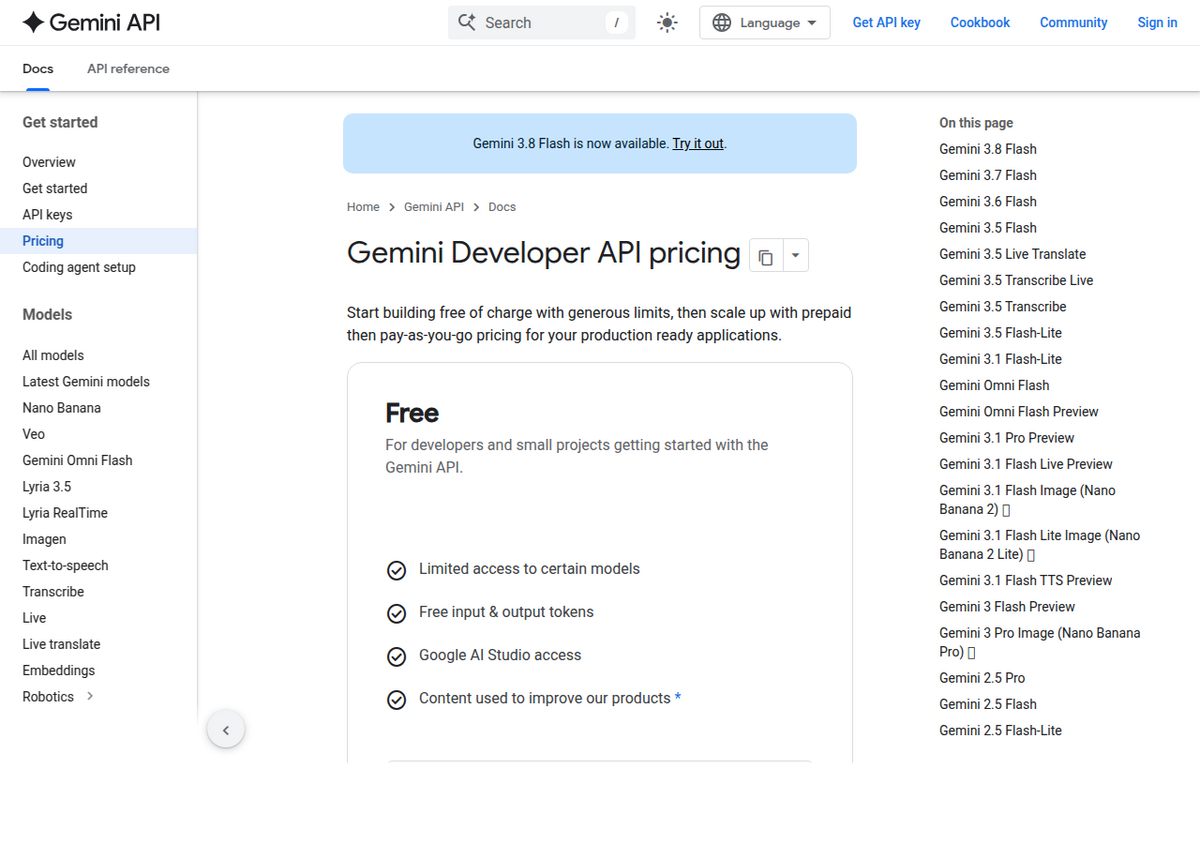
Search for Gemini API pricing and you'll land on calculator sites and cost guides, several dated from mid-2026, quoting a Flash price that's either two generations old or accidentally the price Google starts charging in January 2027. Here's the actual current table, pulled directly from Google's own pricing and billing pages and cross-checked line by line, plus the one date every developer building on Gemini right now should have on their calendar.
Gemini 3.6, 3.7, and 3.8 Flash all currently cost $0.75 per million input tokens and $3.75 per million output tokens. That's an introductory rate that runs through 31 December 2026. On 1 January 2027, all three double to $1.50/$7.50. If you're budgeting a project past the new year, use the higher number.
Gemini 3.1 Pro Preview, the current flagship reasoning model, has no free tier at all, a genuinely counterintuitive fact, since the older Gemini 2.5 Pro still does. If you want to prototype against a Pro-tier model for free, you need the legacy model, not the newest one.
Most third-party pricing trackers we checked are wrong or stale right now, in ways that matter: one lists 3.6 Flash's post-2027 price as today's price, another cites a model name ("Gemini 3 Pro Preview") that Google has since renamed, and two others don't mention the 3.6/3.7/3.8 Flash generation at all.
A "budget alert" is not the same as a spending cap. Multiple developers have reported four- and five-figure surprise bills because Google's alerts only notify, they don't stop billing, unless you separately configure a hard project spend cap, an option Google added in 2026 after a wave of these incidents.
The current pricing table, verified against Google's own page
Every number below comes from ai.google.dev/gemini-api/docs/pricing, timestamped by Google itself as last updated 4 September 2026, cross-checked against Google Cloud's enterprise pricing page for the same models. Prices are Standard tier, per 1 million tokens, in USD. Two multipliers apply across nearly every model on this list: Batch or Flex processing runs at 50% of the Standard rate, and Priority processing costs 1.8x Standard.
Model                        Input $/1M      Output $/1M     Free tier
------------------------------------------------------------------------
Gemini 3.1 Pro Preview       $2.00 (<=200K)  $12.00 (<=200K)  None
                              $4.00 (>200K)   $18.00 (>200K)
Gemini 3.8 Flash             $0.75*          $3.75*           Yes (limited)
Gemini 3.7 Flash             $0.75*          $3.75*           Yes (limited)
Gemini 3.6 Flash             $0.75*          $3.75*           Yes (limited)
Gemini 3.5 Flash             $1.50           $9.00            Yes (limited)
Gemini 3.5 Flash-Lite        $0.30           $2.50            Yes (limited)
Gemini 3.1 Flash-Lite        $0.25 / $0.50a  $1.50            Yes (limited)
Gemini 3 Flash Preview       $0.50 / $1.00a  $3.00            Yes (limited)
Gemini 2.5 Pro               $1.25 (<=200K)  $10.00 (<=200K)  Yes (limited)
                              $2.50 (>200K)   $15.00 (>200K)
Gemini 2.5 Flash             $0.30 / $1.00a  $2.50            Yes (limited)
Gemini 2.5 Flash-Lite        $0.10 / $0.30a  $0.40            Yes (limited)

* Introductory price through 31 Dec 2026. Rises to $1.50 in / $7.50 out
  on 1 Jan 2027 for all three Flash 3.6/3.7/3.8 models.
a Audio input is priced separately/higher than text, image, and video
  input on these models - the second figure is the audio rate.
This table covers the text and reasoning model lineup; Gemini's real-time Live, Omni, Transcribe, and TTS-preview variants are priced separately and out of scope here. Context caching is available on every model above at roughly a 90% discount off the input rate, plus an hourly storage fee (typically $0.50 to $4.50 per million tokens per hour, higher for the Pro-tier models). None of the pricing or billing pages Google publishes for developers state explicit requests-per-minute or tokens-per-minute numbers; those live on a separate rate-limits page and change often enough that we won't reprint a specific figure here, only flag that free-tier and paid-tier RPM/TPM caps are real and worth checking directly before you build around an assumed throughput.
The January 2027 price cliff almost nobody is flagging
This is the single most useful fact for anyone budgeting a Gemini-powered project past the new year, and it's the one every third-party tracker we checked either got wrong or left out entirely. Gemini 3.6, 3.7, and 3.8 Flash, the three models most developers are actually building on right now, are all priced at an introductory $0.75 input / $3.75 output per million tokens through 31 December 2026. On 1 January 2027, that rate doubles to $1.50/$7.50 across all three. It's not a price increase Google is quietly planning; it's already published on the current pricing page, sitting right next to the current rate, and it's easy to miss because the page presents it as a footnote rather than a headline. If your project's cost model assumes today's Flash pricing holds indefinitely, it doesn't, and the doubling isn't small: a workload costing $750 a month in Flash output tokens today costs $1,500 a month from January.
The free-tier gap: the newest Pro model has none
Free-tier availability doesn't track cleanly with how new or capable a model is, and Gemini 3.1 Pro Preview is the clearest example. It's the current flagship reasoning model, and it has no free tier at all, not even a small rate-limited allowance. Every Flash-tier model, from the oldest legacy preview to the newest 3.8 Flash, keeps some form of free access. Gemini 2.5 Pro, the previous-generation Pro model, still does too. So if you want to prototype for free against a Pro-class model's reasoning quality before committing budget, the practical path today is the older 2.5 Pro, not the newer, better-benchmarked 3.1 Pro Preview, purely because of how Google has gated the free tier.
Free-tier billing and how the paid tiers unlock
Gemini API access starts on a free, rate-limited tier available to any active project, no billing account required. Moving to paid access happens in graduated tiers, each unlocking a higher monthly billing cap, verified from Google's own billing documentation:
Tier    Qualification                              Billing cap
----------------------------------------------------------------
Free    Active project or free trial                  N/A
Tier 1  Link an active billing account                 $250
Tier 2  Paid $100+, 3 days after first payment          $2,000
Tier 3  Paid $1,000+, 30 days after first payment       $20,000-100,000+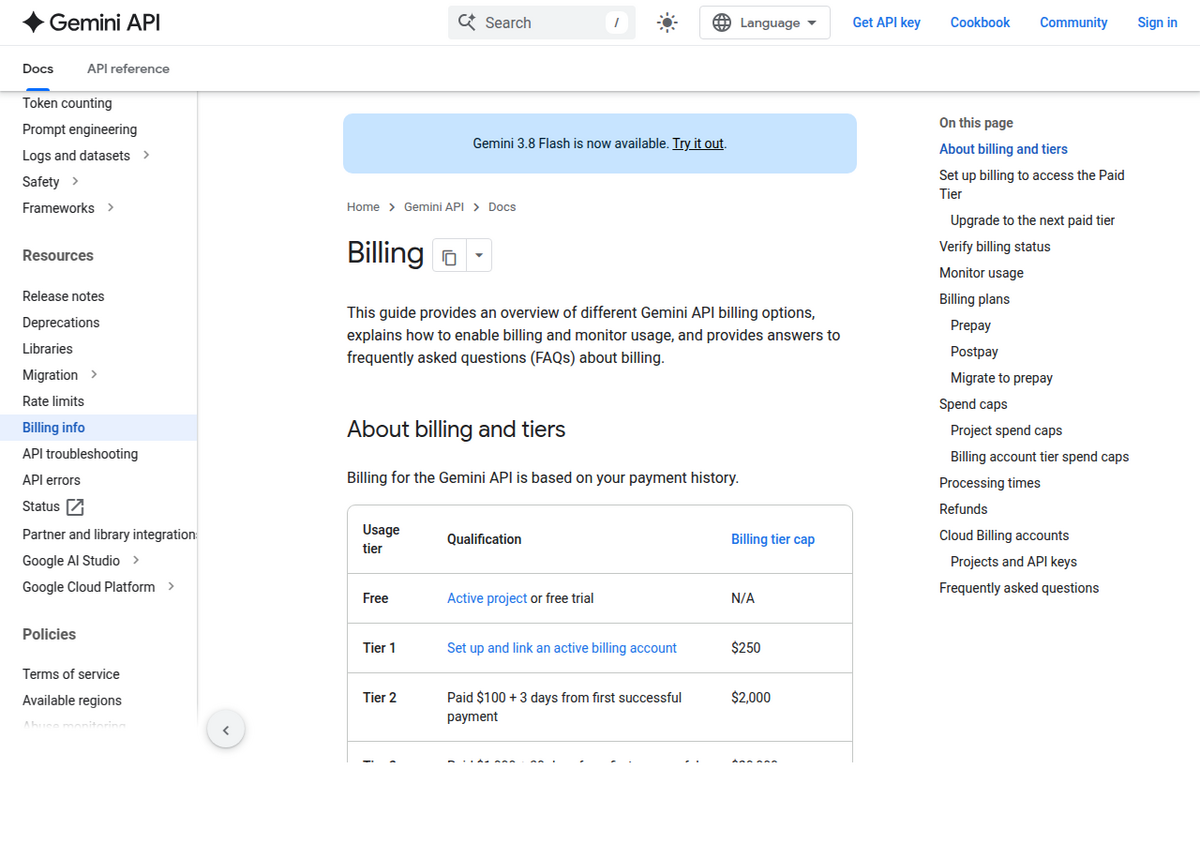
Two billing plans exist within paid tiers: Postpay, the traditional pay-after-usage model, and Prepay, added in 2026, which lets you load funds in advance and caps spending at whatever you've loaded, a materially safer option for anyone who's been burned by a surprise bill (see below). Google also added project-level hard spend caps in 2026 that actually pause a project's API access once a budget is exhausted, distinct from the older budget-alert notifications that only email you after the fact.
Grounding tools cost extra, and the free allowance is smaller than it sounds
If your use case needs the model to ground answers in live Google Search results or Google Maps data, that's billed separately from token usage. Google Search grounding gives Gemini 3.x models a shared 5,000 free requests per month across all 3.x models combined, not per model, then $14 per 1,000 requests. Gemini 2.5 models get a smaller daily allowance instead of a monthly one: 1,500 requests per day shared across 2.5 Flash and Flash-Lite, plus a separate 1,500 RPD for 2.5 Pro, then $35 per 1,000 grounded prompts, roughly 2.5x the 3.x-model rate. Google Maps grounding is cheaper per request ($25/1,000) with a free allowance of 500 requests/day on Flash-tier models or 10,000/day on Pro. If your app leans on grounding for every response, this is frequently the line item that dominates the bill, not the base token price.
Image generation and embeddings
Google's image and embedding models are priced with the same input-token rate as their text-generation counterpart, plus a separate per-output-image or per-output-token charge:
Model                              Input        Image/embedding output
--------------------------------------------------------------------------
Gemini 3 Pro Image (Nano Banana    Same as 3.1  $120/1M tok out =
  Pro)                              Pro Preview   $0.134/image (1K-2K),
                                                   $0.24/image (4K).
                                                   No free tier.
Gemini 3.1 Flash Image (Nano       $0.50 (text) $60/1M tok out =
  Banana 2)                        out $3.00     $0.045-$0.151/image
Gemini 2.5 Flash Image (Nano       $0.30        $0.039/image (1024x1024)
  Banana)
Gemini Embedding 2 (multimodal)    text $0.20/1M, image $0.45/1M
                                    ($0.00012/img), audio $6.50/1M
                                    ($0.00016/sec), video $12.00/1M
                                    ($0.00079/frame). Free tier: yes.
Gemini Embedding (text-only)       $0.15/1M. Free tier: yes.
What actually breaks: alerts aren't caps, and leaked keys are expensive
The pattern across nearly every real Gemini API billing horror story is the same gap: a budget alert notifies you by email, it doesn't stop the meter. Google's own community forums and developer discussions document this repeatedly. One Google AI Developer Forum thread describes a user billed roughly $780 for 1,540 Veo video generations they say should have produced around 20 clips, calling the volume "physically impossible" in the time window; Google support didn't fully resolve the dispute in the thread. A GitHub Discussion on the gemini-cli repository describes a developer who added an API key to the CLI expecting free-tier usage: a $66 bill accrued over three days while consuming 97 million tokens in a single afternoon, then, in a follow-up session, a further $72 in about four hours, far more token volume in both cases than the user believed their actual usage justified. Separately, security researchers at Truffle Security reported finding 2,863 live Google API keys exposed publicly on the web that could authenticate to the Gemini API, because any key tied to a project with the Gemini API enabled becomes a valid Gemini credential, a legacy design detail rather than a Gemini-specific bug, but one that's produced real theft-driven bills in the tens of thousands of dollars reported by outlets including The Register and Tom's Hardware.
The fix in every documented case is the same: don't rely on alert emails as your safety net. Set an actual project-level spend cap (added in 2026, and the only setting that stops billing rather than just notifying you about it), rotate any API key that's ever touched a public repository or client-side code, and consider Prepay billing if you want a hard ceiling by design rather than a setting you have to remember to configure.
Why the pricing calculator you found in search might be wrong today
We checked several of the third-party Gemini pricing pages that rank well for this topic against Google's own primary source, and found real, specific errors worth knowing about if you cross-reference other guides: one tracker's "current" price for Gemini 3.6 Flash is actually the January 2027 post-increase rate, not today's introductory rate. Another article, price-wise accurate for the model it describes, refers to it by a name, "Gemini 3 Pro Preview," that Google has since retired in favor of "Gemini 3.1 Pro Preview," and separately claims that model has no batch or caching discount, which is no longer true. Two other guides we checked simply don't mention the 3.6, 3.7, or 3.8 Flash generation at all, meaning a reader relying on them wouldn't know the current mid-tier Flash lineup even exists. None of this is malicious, pricing pages just go stale fast in a market shipping a new Flash model every three weeks, but it's a good reason to check a date stamp before trusting any pricing guide, including this one; if you're reading this well after September 2026, re-verify against Google's own page before committing budget.
People also ask
Is the Gemini API free to use?
Most Gemini models have a free, rate-limited tier available to any active project with no billing account required, including the current Flash lineup (3.6, 3.7, 3.8 Flash) and Gemini 2.5 Pro. The one notable exception is Gemini 3.1 Pro Preview, the current flagship reasoning model, which has no free tier at all.
How much does Gemini 3.8 Flash cost?
$0.75 per million input tokens and $3.75 per million output tokens, an introductory rate matching 3.6 and 3.7 Flash, in effect through 31 December 2026. From 1 January 2027, the price doubles to $1.50/$7.50.
Why did my Gemini API bill come in much higher than expected?
The most commonly reported cause is confusing a budget alert with a spending cap: alerts only notify you after usage occurs, they don't stop billing. Set an explicit project-level spend cap or switch to Prepay billing (both added by Google in 2026) if you want a hard ceiling. Leaked or public API keys are the other major cause of large surprise bills.
Does Gemini API pricing include Google Search grounding?
No, grounding is billed separately from token usage. Gemini 3.x models get 5,000 free Search grounding requests per month shared across all 3.x models, then $14 per 1,000 requests. Older 2.5 models get a smaller daily free allowance and pay $35 per 1,000 grounded requests.
Is Gemini API pricing cheaper than GPT or Claude?
It depends heavily on which specific model and tier you compare, and pricing across all three providers changes every few weeks, so any single comparison table goes stale fast. Compare the exact model IDs and tiers you plan to use directly on each provider's current pricing page rather than trusting a static comparison.
Ekspor NotebookLM Anda dalam satu klik
Ekstensi Chrome gratis. PDF, Word, dan Markdown. Dirender di perangkat Anda — tidak ada yang diunggah.