Meta Muse Wonder, explained: the frontier model most people can't actually try
Meta shipped its first frontier AI model on 12 October 2026, built by Meta Superintelligence Labs under former Scale AI CEO Alexandr Wang. There are two of them, Muse Wonder and Muse Wonder Full, and the benchmark chart leading Meta's own announcement describes the one almost nobody can use. Here's what each tier actually costs, how it benchmarks against Claude Opus 5.5, GPT-6 Astra and Gemini 4 Argon, and whether a researcher or student could try either one today.
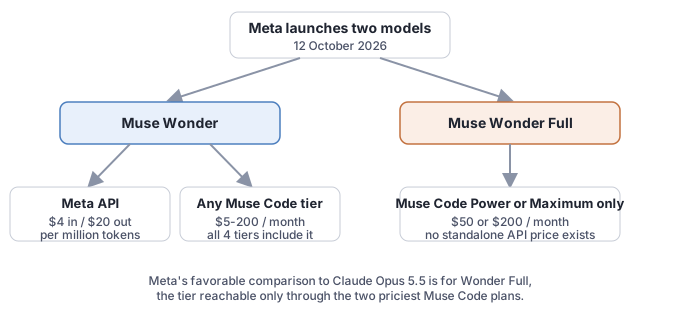
Meta launched two models on 12 October 2026, not one. Muse Wonder is reachable through Meta's API at $4 per million input tokens and $20 per million output tokens. Muse Wonder Full, the stronger model, has no API price at all. It's only reachable through a Muse Code coding-subscription at $50 or $200 a month.
The flattering comparisons are for Wonder Full, not the model you can actually buy by the token. On Artificial Analysis's independent Intelligence Index, Wonder Full scores 56, close to Claude Opus 5.5's 58. The API-reachable Wonder scores 52, and loses 9 of the 14 benchmarks on Meta's own published model-card table to Opus 5.5.
Neither model's weights are public. This is a fully closed launch, unlike Meta's separate open-weight "Muse Glimmer" model released earlier in 2026.
There's no free way to try either model today. No chat playground exists for Wonder or Wonder Full comparable to chatgpt.com or claude.ai. You need a developer API key and a credit card, or a Muse Code subscription from $5 a month, though reaching Wonder Full specifically requires the $50 or $200 tier.
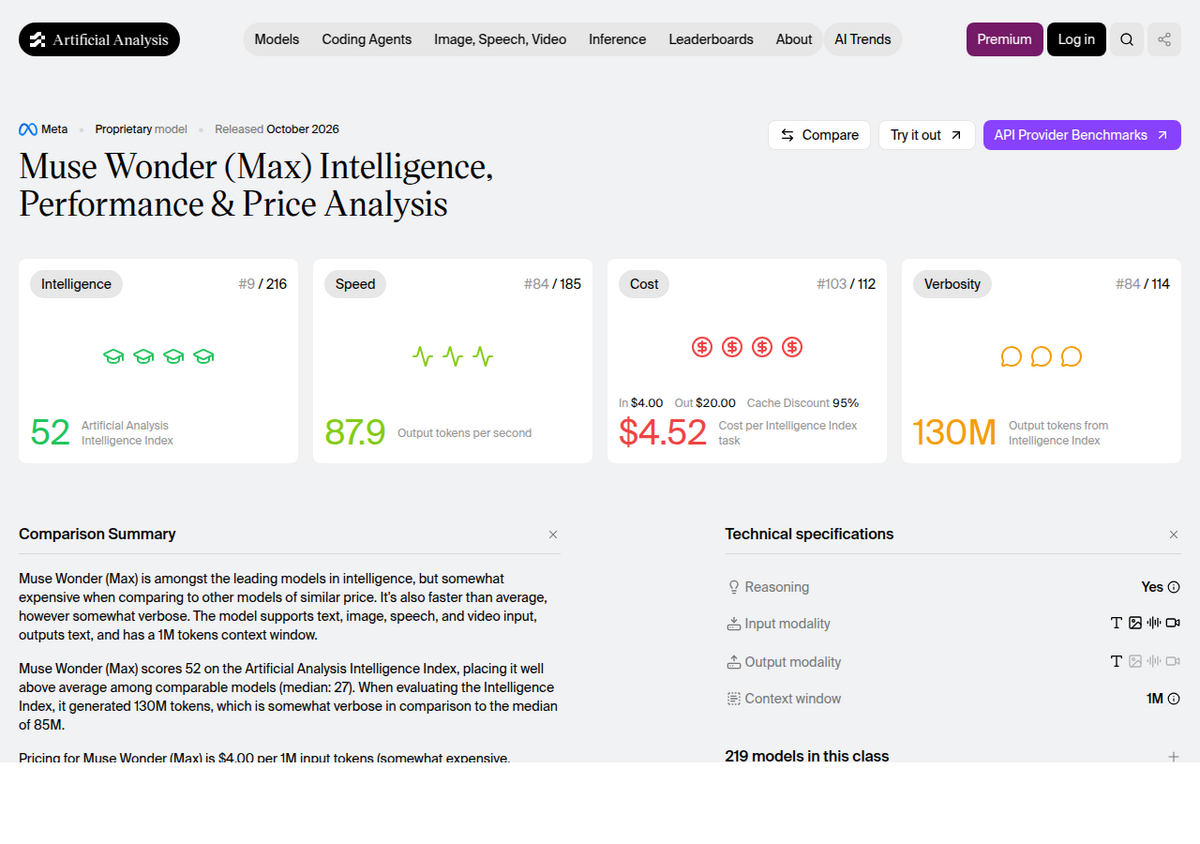
What Meta actually announced
Muse Wonder is Meta's first model described internally as "frontier," launched 12 October 2026 and built by Meta Superintelligence Labs, the research group Mark Zuckerberg formed in mid-2025 and put Alexandr Wang in charge of after acquiring a stake in Scale AI. It follows Muse Spark, a smaller proprietary model the same lab shipped in April 2026, and a separate consumer agent app simply called Muse that launched in September 2026 for shopping, email and trip-planning. Wonder is a different product from both: a frontier-scale model aimed at developers and, eventually, Meta's own products, not a chat app you install.
Both Wonder and Wonder Full take text, image, audio and video as input and produce text output only. Neither model generates images. Meta's API documentation lists a roughly 1,048,576-token (about 1M) context window for both. That figure comes from Meta's own published docs; no independent source we found has tested long-context recall against it, so treat it as a stated capacity rather than a verified one.
Two models, two tiers, and that's the catch
Model               How to access it                          Price
-----------------------------------------------------------------------------
Muse Wonder          Meta Model API (model id                 $4.00 / M input
                     muse-wonder-1.0), OpenAI/Anthropic-        $0.20 / M cached
                     SDK compatible; or any Muse Code tier     $20.00 / M output
                     (Everyday $5/mo and up)                   +$2.50 / 1,000
                                                                  web searches

Muse Wonder Full     Muse Code "Power" ($50/mo) or              No standalone
                     "Maximum" ($200/mo) tier only               API price exists
                                                                  at any price

Figures per Meta's own developer docs and Muse Code pricing, as reported by
VentureBeat and Kingy.ai, 12-13 October 2026.
Muse Code itself is Meta's answer to Claude Code and OpenAI's Codex, a terminal and IDE coding-agent tool with its own ladder of plans: Everyday ($5/mo), High Usage ($15/mo), Power ($50/mo) and Maximum ($200/mo), plus a pay-as-you-go option. All four tiers include standard Muse Wonder. Only Power and Maximum include Wonder Full. In other words: the model Meta's chart compares favorably to Claude Opus 5.5 is gated behind a developer tool's two priciest subscription tiers, not sold on its own.
How it actually benchmarks, independently checked
Model                  Artificial Analysis Intelligence Index
--------------------------------------------------------------
Claude Opus 5.5         58
Muse Wonder Full         56
GPT-6 Astra              53
Claude Fable 5.1         53
Gemini 4 Argon           53 (run at "high" effort, not "max")
Muse Wonder              52

Source: Artificial Analysis, independently cross-confirmed by VentureBeat
and Kingy.ai, 12 October 2026.
That single number, from Artificial Analysis's independent benchmark page, is the most favorable read for Meta: Wonder Full lands two points behind Opus 5.5, ahead of GPT-6 Astra, Claude Fable 5.1 and Gemini 4 Argon. It gets worse the closer you look. Meta's own model card lists 14 benchmarks comparing Wonder Full and the API-reachable Wonder against GPT-6 Astra and Claude Opus 5.5, and a close independent read of that table finds the actually-available Wonder loses 9 of the 14 rows to Opus 5.5, including ProgramBench (50.0 vs 70.5), OSWorld V2.1 (72.6 vs 81.8) and Terminal-Bench 4.0 (52.0 vs 59.6). Wonder wins outright on only four: Harvey LAB-AA (a legal-document benchmark), DeepSWE 1.1, SWE-Marathon and MemoryBench.
Meta's own disclosure adds caveats worth taking at face value rather than dismissing as outside skepticism: the model card states results mix self-reported numbers, "best of" internally-validated runs, and non-controlled harnesses for SWE-Marathon specifically, and that effort settings weren't applied consistently across the comparison, Gemini 4 Argon was run at "high" rather than "max," and Wonder Full's own SWE-Marathon score reportedly used "xhigh" effort against a table header that just says "max." None of that makes the numbers fake. It does mean the headline "ties Claude Opus 5.5" framing repeated by some launch-day coverage describes Wonder Full under favorable settings, not the model most developers will actually be billed for.
Can you actually try Muse Wonder today?
This is the question most launch-day coverage skipped, and it's the one that matters most for a reader deciding whether to bother. The short answer: not casually. There's no equivalent of chatgpt.com, claude.ai or gemini.google.com for Muse Wonder, no free account you create to start chatting. The two real entry points are a developer API key billed per token, or a Muse Code subscription aimed at software engineers, from $5 a month. Every Muse Code tier includes standard Muse Wonder; reaching Wonder Full specifically requires the $50 or $200 monthly tier.
Meta's separate consumer Muse app, the one that handles shopping and email, isn't running on Wonder yet either. Meta says Wonder will power more of that app "soon," rolling out first to subscribers, with no firm date given as of this writing. So for a researcher or student reading this hoping to try Meta's new flagship the way they'd try a new Gemini or Claude model, the honest answer today is: you can't, unless you're also a developer with billing set up, or willing to pay for a coding tool you may not otherwise need.
What Meta says about safety
Meta's own research blog describes Wonder as trained under its "Superintelligence Scaling Framework" with what it calls its strongest safeguards to date against chemical, biological and cyber misuse, and the most aligned model it has shipped. Meta's model card for the launch is more cautious than the press framing: Meta states it cannot rule out the unmitigated Wonder Full model crossing its own high-risk threshold for chemical or biological misuse, and that a fuller safety report is "coming soon" rather than published alongside launch. The same model card puts Wonder's personal-information mishandling rate, how often the model shares private information without permission, at 3.4%, the best score in its comparison table, though still roughly 1 in 30.
Where this leaves the rest of the field
Muse Wonder's real position is narrower than Meta's launch framing: the API model you can actually buy sits a step behind Claude Opus 5.5, GPT-6 Astra, Claude Fable 5.1 and Gemini 4 Argon on most task-specific benchmarks, priced identically to Opus 5.5 ($4/$20 per million tokens) despite scoring lower on Artificial Analysis's aggregate index. Whether Wonder Full changes that picture is unresolved for most people, since it isn't something you can rent by the token to find out. If you're evaluating frontier models for a research or writing workflow rather than software engineering, Claude Opus 5.5 remains the stronger documented option today, and Mistral's own freshly-launched Mistral Large 4 is at least priced and benchmarked the same way for everyone, rather than splitting into a buyable tier and a flattering-chart-only tier.
People also ask
What is Meta's Muse Wonder?
Meta's first model described as "frontier," launched 12 October 2026 by Meta Superintelligence Labs. It ships in two versions: Muse Wonder, reachable through Meta's API at $4/$20 per million input/output tokens, and Muse Wonder Full, a stronger version only available through a $50 or $200/month Muse Code subscription with no standalone API price.
Is Muse Wonder free to use?
No. There's no free chat playground for either model. Muse Wonder requires a developer API key billed per token, or any Muse Code subscription (from $5/month). Muse Wonder Full specifically requires the $50 or $200/month tier.
Is Muse Wonder as good as Claude Opus 5.5?
Only Muse Wonder Full comes close, scoring 56 on Artificial Analysis's Intelligence Index against Opus 5.5's 58. The actually API-purchasable Muse Wonder scores 52, and loses 9 of the 14 benchmarks on Meta's own published comparison table to Opus 5.5, despite being priced identically at $4/$20 per million tokens.
Are Muse Wonder's weights open source?
No. Neither Wonder nor Wonder Full has public weights; both are fully closed. This is a different approach from Meta's separate open-weight "Muse Glimmer" model released earlier in 2026.
Can I use Muse Wonder for research or document work instead of Gemini Notebook or Claude?
Not practically today. There's no consumer app running Wonder, only a developer API and a coding-focused subscription product. If you need a source-grounded research or document tool right now, Gemini Notebook, Claude or ChatGPT all have accessible consumer apps that Muse Wonder currently doesn't.
Wyeksportuj swój NotebookLM jednym kliknięciem
Darmowe rozszerzenie do Chrome. PDF, Word i Markdown. Renderowane na Twoim urządzeniu — nic nie jest wysyłane.