OpenAI says 10,000 AI agents solved a Millennium Prize problem, and no outside mathematician has checked the proof yet
On 8 September 2026, OpenAI published a 165-page proof claiming to resolve a version of the Navier-Stokes existence-and-smoothness problem, one of the seven Clay Mathematics Institute Millennium Prize problems, each carrying a $1 million award. The company says roughly 10,000 AI agents, running an unreleased model, produced the result in about 88 hours. OpenAI isn't claiming the prize money, several tech-press outlets have already mischaracterized why, a credit dispute with a researcher at Anthropic is playing out in public, and as of this writing, no mathematician outside OpenAI has confirmed reading the full proof.
OpenAI says its agents proved a forced version of 3D Navier-Stokes can break down in finite time (a "finite-time blowup"), not the full, harder unforced case that has stumped mathematicians for decades. The unforced problem remains open.
OpenAI explicitly is not claiming the $1 million Clay Institute prize. Several outlets reported this is because OpenAI "solved the wrong problem." We checked the Clay Institute's official problem statement directly: that's incorrect. The real reason is almost certainly procedural: Clay's rules require publication in a refereed journal and two years of community acceptance before any prize is even considered.
A credit dispute is unresolved. NYU mathematician Tristan Buckmaster says OpenAI researcher Sébastien Bubeck pressured his collaborator, Anthropic employee Levent Alpöge, to drop his name from a related paper because of his employer. Bubeck denies wrongdoing; OpenAI says it "cannot rule out" that anonymized usage data indirectly helped its models. Anthropic itself has made no statement.
No independent mathematician has confirmed reading OpenAI's full proof yet. Three weeks on, that's still true. The Clay Institute's president called evaluation "deliberately unhurried."
Update, 1 October 2026: since this story broke, 25 Fields Medalists (including Terence Tao) published a joint declaration criticizing rushed AI math announcements industry-wide, a separate group of mathematicians posted a proof that OpenAI's specific technique can never be extended to the real, unforced problem, and Bubeck publicly apologized for one remark Buckmaster says was a veiled threat, while disputing Buckmaster's account of it. Details below.
What OpenAI actually claims
Per OpenAI's own announcement, a swarm of on the order of 10,000 concurrent AI agents, running a next-generation model the company describes only as "significantly more capable than GPT-6 Astra," worked from 1 September to roughly 5 September 2026 (about 88 hours) to produce a proof that a specific, carefully constructed version of the 3D Navier-Stokes equations can produce a singularity in finite time. A further ~17 hours, using GPT-6 Astra specifically, produced a Lean formalization, a machine-checkable version of the proof's logical steps. OpenAI's own figures put the Navier-Stokes run at roughly 2.7 million agent messages and about 130 billion output tokens; independent commentator Simon Willison, working from numbers he was given, put the combined figure (likely including related work on the Euler equations) closer to 300 billion tokens, which he calculated would cost around $15 million at public API rates. Neither figure has been reconciled publicly, and OpenAI has stated only that the total cost ran into "millions of dollars."
The specific mathematical claim matters more than the headline. The Navier-Stokes equations describe how fluids move, and come in a forced version (with an external force term, like gravity, acting on the fluid) and an unforced version (no outside force). OpenAI's result is about the forced case: it describes a configuration of smooth, physically reasonable initial conditions and a smooth external force under which the fluid's motion tightens into an ever-faster spinning vortex and becomes non-smooth in finite time, while the fluid's total energy stays bounded throughout. The unforced case, the version most people picture when they hear "Navier-Stokes problem," remains unsolved.
The "wrong problem" claim is itself wrong
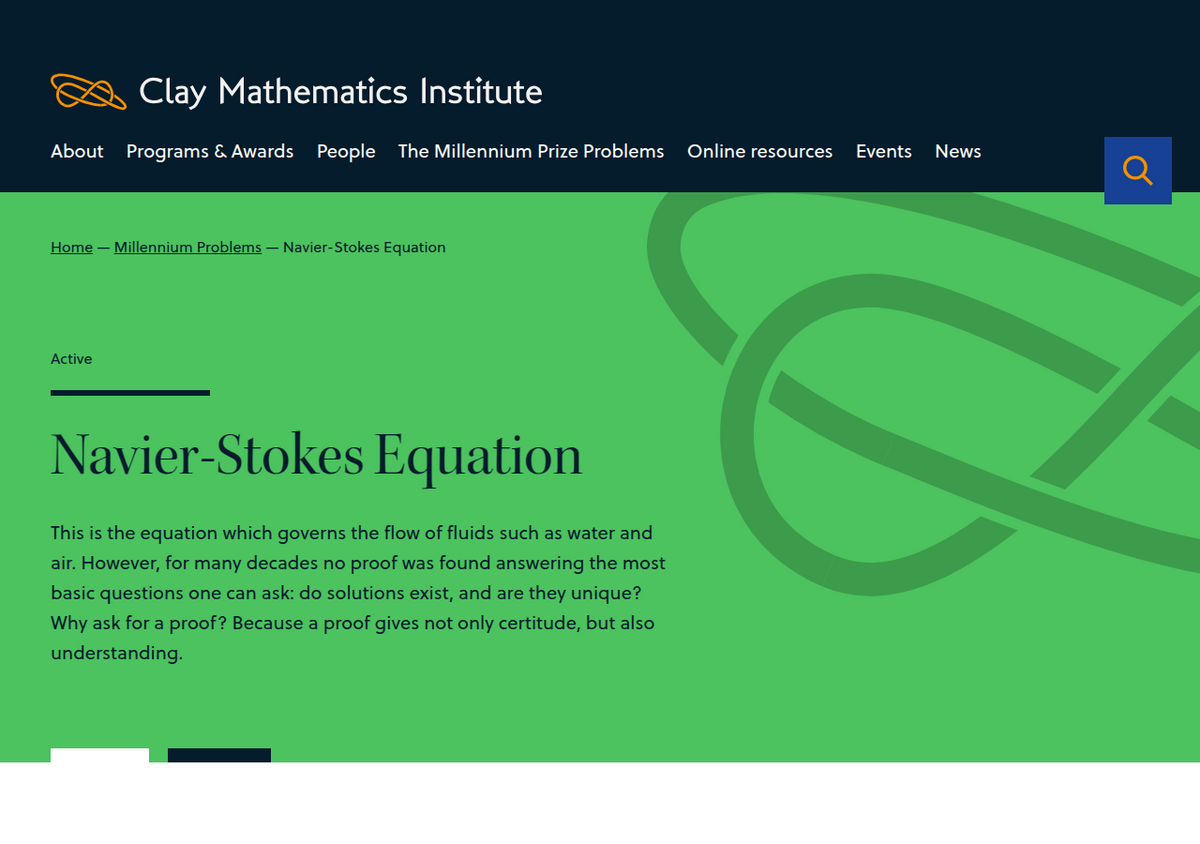
Several outlets covering the story, including a piece from Forkast News, framed OpenAI's decision not to claim the $1 million prize as evidence it had solved a different, easier problem that falls outside the Clay Institute's rules. We pulled the Clay Institute's own official problem description, written by Princeton mathematician Charles Fefferman, directly. It lays out four distinct, equally valid formulations of the problem, labeled (A) through (D). Two of them, (A) and (B), ask for a proof that smooth solutions always exist, with no external force. The other two, (C) and (D), explicitly allow a smooth external force term and ask for the opposite: a proof that a solution can break down (a formal counterexample to global smoothness). A forced finite-time blowup, which is what OpenAI says it found, fits the plain language of case (C) or (D), not "a different problem."
Fefferman's four official problem statements (Clay Mathematics Institute)
---------------------------------------------------------------------
(A) Existence & smoothness on R^3, force = 0    -> prove solutions always exist
(B) Existence & smoothness on the 3D torus, force = 0 -> same, periodic case
(C) Breakdown on R^3, smooth force allowed      -> prove a solution CAN break down
(D) Breakdown on the 3D torus, smooth force allowed -> same, periodic case

OpenAI's claim (forced blowup on R^3) matches the shape of (C).
So why isn't OpenAI claiming the prize? The far more plausible explanation is procedural, not mathematical. Under the Clay Institute's current rules, a proposed solution has to be published in a recognized, refereed mathematics journal, then wait a minimum of two years while it earns general acceptance from the mathematics community, before the Institute's Scientific Advisory Board will even convene a review committee. A 165-page proof released four days ago, checked internally by the company that produced it, simply hasn't cleared that bar yet, whatever the underlying math turns out to be worth. That's a meaningfully different story than "solved the wrong equation," and it's the one the primary sources actually support.
The credit dispute
The math isn't the only controversy. According to reporting from Axios, Fortune, and CNN, OpenAI's Sébastien Bubeck began this project on 1 September after hearing rumors that two Millennium-caliber problems had already been solved elsewhere. That rumor traced back to NYU mathematician Tristan Buckmaster and Levent Alpöge, an Anthropic employee working on the side in a personal capacity, not as an official Anthropic project. Alpöge contacted OpenAI on the night of 2 September after the pair learned word of their unpublished work had already reached the company; Buckmaster followed up on 3 September to explain the project was personal rather than an official Anthropic initiative; outside pressure to move fast afterward is part of why their Euler write-up came out rough, something Buckmaster later described as "AI slop." Their separate results addressed related but distinct problems: finite-time blowup with smooth forcing for the incompressible porous medium equation, the Boussinesq system, and 3D incompressible Euler, which OpenAI's own post explicitly credits them for having priority on. Only the porous-medium result had reached arXiv as a formal preprint by the time OpenAI published; the Boussinesq and Euler write-ups existed as PDFs and a Lean-verified proof on Buckmaster's own site, with their own paper describing those two as forthcoming.
During a call on 6 September, Bubeck pushed to have Alpöge dropped from co-authorship on the grounds that his Anthropic affiliation made his involvement awkward, allegedly telling Buckmaster "Why would you ruin your career?" and, when pressed, "If you don't want me to be nice, then I don't have to be nice." Bubeck disputes the characterization, calling the allegations "false and inflammatory" and stating on the record, "We did not use their prompts or proofs to prompt our models or direct our agents." OpenAI's own statement to VentureBeat goes further than a flat denial, however: "We cannot rule out that de-identified data derived from their usage of our products helped improve our models," while maintaining no specific user data was accessed to solve this particular problem. Buckmaster's own position is measured: "I do not know whether our data was used. I am not accusing anyone of anything." Anthropic, as a company, has not issued any statement; every quote attributed to "the Anthropic side" of this dispute is Alpöge speaking personally, at one point describing his own work as "me and claude having a good time yoloing random stuff in the corner rather than anything institutional."
On 8 September, per TheNextWeb, Bubeck posted his own account on X, writing "I never ever asked for Levent to be removed from authorship of his own work," and apologized for a specific comment from the same private call. As evidence, he shared a screenshot of a message to Alpöge proposing a coordinated joint release, writing he hoped it showed "the best possible intentions." Buckmaster responded publicly that Bubeck's account still misrepresented what was actually said. Sam Altman backed Bubeck less than 30 minutes later, posting that everyone involved "acted with integrity and generosity throughout," and that once OpenAI realized Buckmaster and Alpöge had solved Euler but not Navier-Stokes, it had offered to let them publish first, suggested they should receive the prize, and offered Buckmaster lead authorship on a rewrite of OpenAI's own proof. As of this update, neither side has retracted its account, and the dispute remains unresolved rather than settled.
What's happened since: a math-community rebuke, and a new objection to the proof itself
Three weeks after OpenAI's announcement, the most significant response hasn't come from either company, it's come from the mathematics community as a whole. On 11 September 2026, 25 Fields Medalists, including Terence Tao, Peter Scholze, Maryna Viazovska, and Manjul Bhargava, published a joint declaration on Tao's blog titled "A Severe Misalignment of AI in Mathematics", open for further signatures. The declaration doesn't name OpenAI or Anthropic and doesn't dispute the correctness of any specific proof. Its argument is about process: AI labs chasing benchmark problems for headlines are, in the signatories' words, turning mathematics into a "mass production" of true-or-false statements that displaces the conceptual understanding, attribution, and community vetting the field actually runs on. Per reporting on the declaration, the group decided the situation was urgent enough to skip the more consultative drafting process similar statements usually go through.
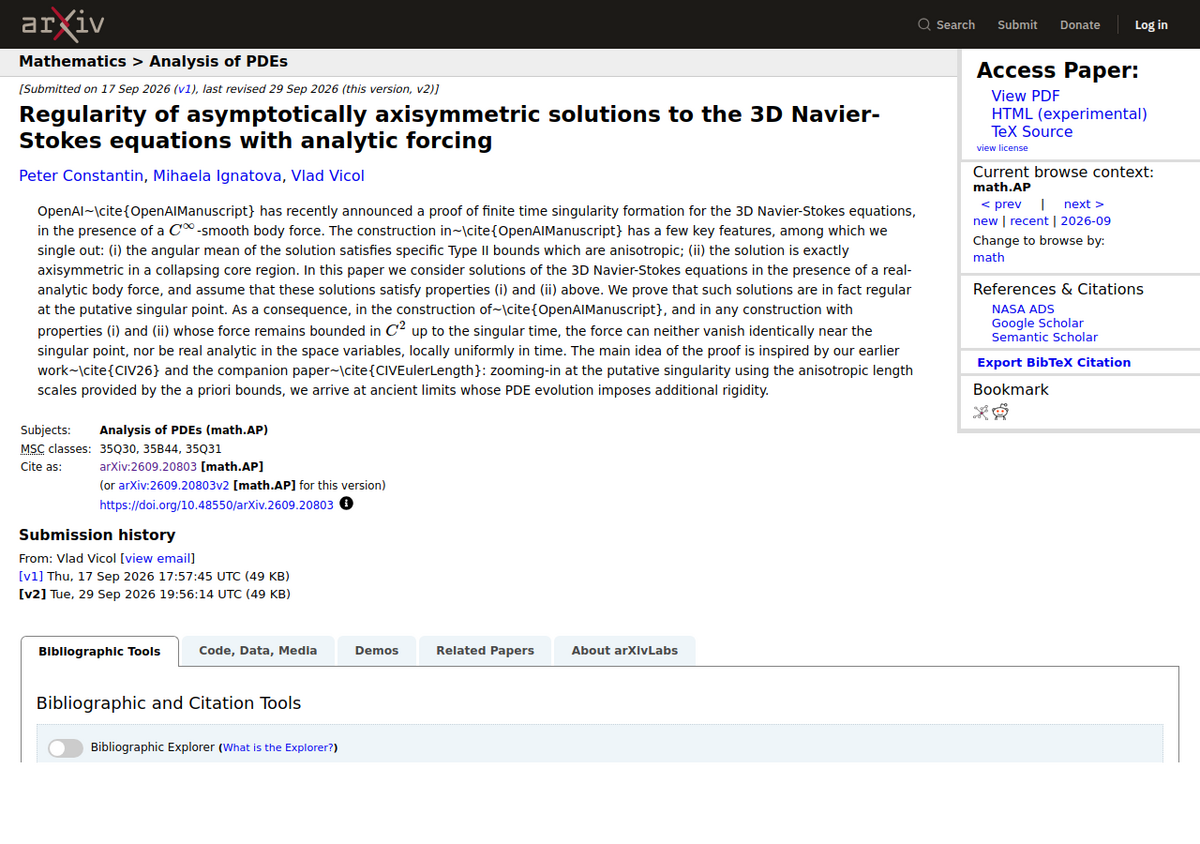
Separately, a direct mathematical objection to OpenAI's construction surfaced on 17 September (revised 29 September), when Princeton's Peter Constantin, Mihaela Ignatova, and Vlad Vicol posted a paper on arXiv titled "Regularity of asymptotically axisymmetric solutions to the 3D Navier-Stokes equations with analytic forcing." Their precise result, read directly from the paper's own abstract, is narrower than a blanket rebuttal: for any construction sharing OpenAI's two key structural features, they prove the external force driving the blowup "can neither vanish identically near the singular point, nor be real analytic in the space variables." Put plainly, OpenAI's forcing term has to stay artificially active and non-smooth right at the point of breakdown, which is exactly the trait a real, physically occurring force (gravity, pressure, anything with no outside agent switching it on) wouldn't have. University of Chicago mathematician Luis Silvestre summarized the upshot to Scientific American: "The Clay problem is settled, but the main problem for the Navier-Stokes equations is not." That isn't a new claim so much as a sharper, formally-proven version of this article's original point: the Clay Institute's literal problem statement does permit a forced case (so OpenAI's result is a genuine answer to a genuine formulation), but this new paper gives a concrete technical reason the construction can't be pushed toward the unforced, physically intuitive version mathematicians actually care about. Other mathematicians quoted in the same piece, including Diego Córdoba and Gonzalo Cao-Labora, went further, suggesting in hindsight that the Clay Institute's 2000 problem statement may have been a drafting mistake for including the forced option at all.
What mathematicians outside both labs are actually saying
It's worth separating reactions to the *situation* from verification of the *math*, because most of the public commentary so far is the former. Clay Mathematics Institute president Martin Bridson called it "an exciting day," but stopped well short of an endorsement, telling Nature that evaluation will be "deliberately unhurried" and "absolutely rigorous." Fefferman himself, the author of the official problem statement, said he was "thrilled that the problem was solved." Quanta Magazine's own reporting flags the real limit of a Lean formalization regardless of whose proof it checks: the crucial verification that still has to be done by humans is confirming that the statement being shown true inside Lean is logically equivalent to what mathematicians actually set out to prove. A machine proof-checker can confirm a chain of logical steps is internally consistent; it can't confirm, on its own, that the formalized statement is actually the theorem anyone cares about.
Terence Tao, commenting on the Buckmaster/Alpöge side of the story rather than OpenAI's proof directly, called it "a remarkable achievement" but used the moment to raise a broader concern: "this very strange and unprecedented decoupling, this year alone, between getting answers and getting understanding," comparing the experience to "going to watch a movie and jumping straight from the first ten minutes to the last ten minutes; technically, all the plot lines are resolved, but most of the value of the experience was lost." He also warned that a rumor-driven race to publish first discourages mathematicians from sharing promising partial results early, the opposite of how the field is supposed to work. Columbia number theorist Michael Harris, writing on his Silicon Reckoner blog, was blunter about the conduct while being explicit about the limits of his own knowledge: "I have not seen OpenAI's proof. I do not know what their model did, or how," before calling the reported compute spend "demeaning to mathematics." As of publication, we found no mathematician, on either side of the dispute or outside it, who has stated they personally read and checked OpenAI's full 165-page proof.
Why this matters if you use AI for research
You probably aren't proving Millennium Prize problems with Gemini Notebook or NotebookLM. But the pattern here is one worth recognizing at any scale: a confident, well-formatted, even formally-checked AI output is not the same thing as an independently verified one. Lean formalization is a genuinely useful tool, and it's a stronger form of self-checking than most AI-generated content ever gets. It still isn't peer review, and it can't catch a mismatch between what was formalized and what was actually meant. The same caution applies to citations and summaries a research tool hands you from your own source documents: check the specific claim against the primary source before you build on it, the same way this story itself is still waiting on someone to do.
People also ask
Did OpenAI solve the Navier-Stokes Millennium Prize problem?
OpenAI's agents produced a proof for a forced version of the 3D Navier-Stokes equations, showing a specific configuration where smooth flow breaks down in finite time. The harder, more commonly cited unforced version of the problem is still unsolved. As of this writing, no mathematician outside OpenAI has publicly confirmed reading and checking the full proof.
Why isn't OpenAI claiming the $1 million prize?
OpenAI hasn't said explicitly, but the Clay Mathematics Institute's own rules require a proposed solution to be published in a refereed journal and hold up for at least two years of community scrutiny before any prize review even begins. A four-day-old, internally-checked proof simply can't have cleared that bar yet, independent of how the mathematics eventually holds up.
Is it true OpenAI solved "the wrong problem"?
No. The Clay Institute's official problem statement (written by Charles Fefferman) explicitly includes formulations that permit an external force and ask for a breakdown/counterexample, which is the shape of OpenAI's claim. Coverage describing this as an unrelated or invalid problem misreads the actual rules.
What is the dispute with Anthropic about?
NYU mathematician Tristan Buckmaster says OpenAI's Sébastien Bubeck pressured his collaborator Levent Alpöge, an Anthropic employee working personally rather than on an official Anthropic project, to drop his name from a related paper because of his employer. Bubeck denies wrongdoing. Anthropic as a company has made no public statement.
Has anyone independently verified OpenAI's proof?
Not as of this update. Every mathematician quoted publicly so far, including the Clay Institute's own president, is reacting to the situation or to a specific technical gap in the proof's scope, rather than confirming they've personally read and checked the full document line by line.
Has anyone shown a problem with OpenAI's proof?
Yes, though not an error in the math itself. A separate group of mathematicians posted a proof on arXiv in mid-September showing OpenAI's forced-blowup technique can never be extended to say anything about the real, unforced Navier-Stokes problem. University of Chicago mathematician Luis Silvestre summarized it: the narrow, forced version of the Clay problem is settled, but the harder problem mathematicians actually care about is not.
What did the Fields Medalists say about this?
On 11 September 2026, 25 Fields Medalists, including Terence Tao, published a joint declaration criticizing the broader pattern of AI labs racing to claim benchmark math problems, arguing it displaces the conceptual understanding and attribution process mathematics depends on. The declaration doesn't name OpenAI or Anthropic specifically and doesn't dispute any proof's correctness.
Esporta il tuo NotebookLM in un clic
Estensione gratuita per Chrome. PDF, Word e Markdown. Elaborata sul tuo dispositivo — niente viene caricato.